姤
Character Story & Explanation
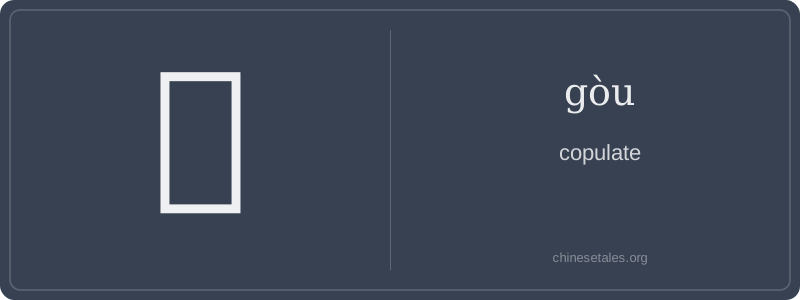
The earliest form of 姤 appears in bronze inscriptions as a compound: a woman radical (女) paired with a phonetic component that resembled 句 (jù) — not the modern 句, but an older glyph suggesting a bent shape or coiling motion. In oracle bone script, it wasn’t pictographic of intercourse itself, but of *encounter*: two lines converging, with the woman radical anchoring the meaning. Over centuries, the phonetic shifted from 句 to 后 (hòu), then simplified into the modern upper part — a stylized 'hook' () above 'mouth' (口), which actually evolved from a distorted 句. The lower 女 radical remained constant, grounding the character in gendered cosmology.
This character first appeared in the Yijing (c. 10th–3rd century BCE) as the name of Hexagram 44, composed of one yin line at the bottom beneath five yang lines — symbolizing the subtle, inevitable emergence of yin (feminine principle) within overwhelming yang (masculine force). Confucian commentators read 姤 as 'fateful meeting'; Daoists saw it as the spark of creation. Its visual structure — a 'hook' descending toward the 'woman' — mirrors the hexagram’s imagery: a single yin line 'hooking' into the yang field. No other character so tightly binds graphic form, cosmological metaphor, and semantic precision.
Think of 姤 (gòu) as the Chinese linguistic equivalent of Shakespeare’s 'to lie with' — elegant on the surface, deeply charged beneath. It doesn’t mean 'have sex' in casual or modern spoken Mandarin; it’s a classical, almost ritualistic term for copulation — specifically the *initial union* between male and female, carrying connotations of cosmic alignment, not biology. You’ll never hear it in a dating app or medical textbook; it lives in ancient cosmology, Daoist texts, and the Yijing (I Ching), where it names Hexagram 44: Gòu — 'Coming to Meet', symbolizing sudden, fateful encounter.
Grammatically, 姤 is almost never used as a verb in contemporary speech or writing. It appears only as a proper noun (e.g., 姤卦 gòu guà, 'the Gou hexagram') or in highly literary, archaic compounds. Learners mistakenly try to conjugate it like 睡 (shuì, 'to sleep') — but 姤 has no aspect particles (no 姤了, no 正在姤), no object markers, and zero colloquial usage. Its function is lexical, not verbal: it names a *principle*, not an action.
Culturally, misusing 姤 is like quoting Genesis 2:24 ('they shall become one flesh') in a Tinder bio — technically accurate, wildly inappropriate. Even advanced learners avoid it outside scholarly contexts. A common error is confusing its pronunciation (gòu) with 购 (gòu, 'to purchase') or 构 (gòu, 'to construct'), leading to unintentionally risqué homophone jokes. Remember: this character isn’t about desire — it’s about destiny meeting design.