姘
Character Story & Explanation
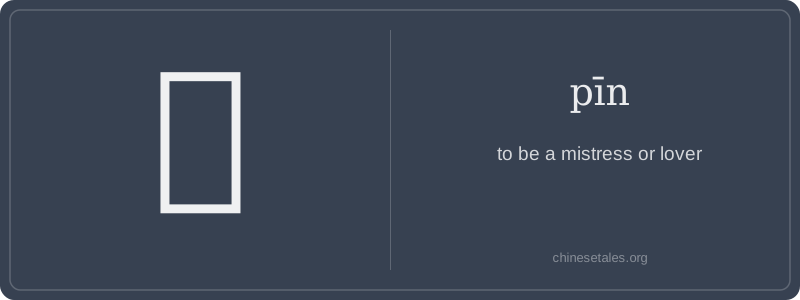
The earliest form of 姘 appears in Han dynasty clerical script, not oracle bones — it’s a relatively late-comer among Chinese characters. Visually, it combines 女 (nǚ, 'woman') on the left with 平 (píng, 'flat, level') on the right. That right-hand component wasn’t originally about flatness: in ancient phonetic loan usage, 平 served as a *sound hint* (phonetic component), approximating the pronunciation pīn. Over centuries, the shape stabilized into today’s nine-stroke form — three strokes for 女 (the 'skirt' dot, two 'legs'), six for 平 (two horizontal lines, a vertical, then three connected strokes forming the lower 'platform'). The left radical anchors gender; the right locks in sound — no pictorial trickery, just elegant phonosemantic design.
Meaning-wise, 姘 emerged during the Ming-Qing era as vernacular fiction flourished — think novels like *The Plum in the Golden Vase*, where marital infidelity was dissected with surgical precision. Here, 姘 wasn’t just descriptive; it carried Confucian weight — implying imbalance (hence 平’s ironic presence: the relationship is *not* 'level' or 'proper'), social disruption, and female vulnerability within patriarchal structures. Classical texts avoided it, preferring terms like 外室 ('outside household') or 偏房 ('side chamber'). Its visual simplicity masks deep cultural tension: a 'flat' character for something profoundly *unstable*.
At first glance, 姘 (pīn) feels like a linguistic landmine — it’s not in the HSK, rarely taught in textbooks, and carries strong social gravity. Its core meaning isn’t just 'lover' but specifically a *woman in a secret, non-marital, often socially stigmatized relationship*, usually with a married man. Think less 'romantic partner' and more 'kept woman' — the tone is judgmental or clinical, never neutral or affectionate. You’ll almost never hear it in casual speech; it appears in news reports, legal documents, or moral critiques — always with subtle disapproval baked in.
Grammatically, 姘 is almost always a noun (e.g., 他有个姘头 — 'He has a mistress'), not a verb. Learners sometimes mistakenly try to use it like 'to date' (e.g., *她姘他*), but that’s ungrammatical and unnatural. Instead, it pairs with verbs like 有, 养, or 当: 养姘头 ('keep a mistress'), 当姘头 ('be someone’s mistress'). Notice the radical 女 (female) — this character centers female identity, but crucially *not* agency: it reflects how society labels women in such roles, not how they self-identify.
Culturally, using 姘 casually can sound archaic, harsh, or even offensive — like calling someone a 'mistress' in English instead of 'partner' or 'girlfriend'. Younger speakers often avoid it entirely, opting for euphemisms like 外遇对象 ('extramarital partner') or just 朋友 ('friend', with heavy air quotes). A common learner trap? Confusing it with 平 (píng, 'flat') or 拼 (pīn, 'to strive') — sounds alike, meanings wildly apart. Remember: if your sentence implies moral judgment or social censure, you *might* need 姘 — but tread carefully.