姒
Character Story & Explanation
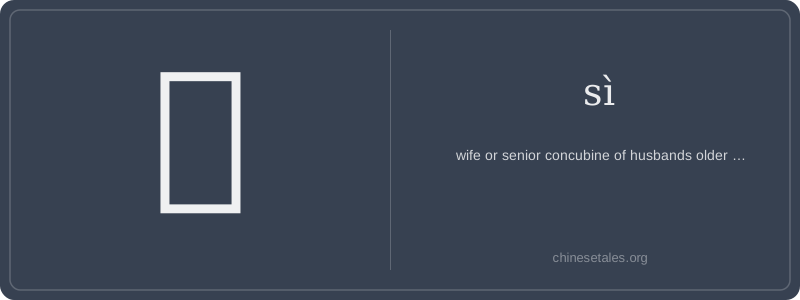
The earliest form of 姒 appears on Western Zhou bronze inscriptions as a pictograph combining 女 (nǚ, 'woman') on the left and 司 (sī, 'to manage, oversee') on the right — though in oracle bone script, the right side resembled a simplified hand holding a ritual vessel, hinting at ceremonial authority. Over centuries, the right-hand component evolved from a vessel-hand motif into the more abstract 司 shape, while the left-side 女 radical remained stable, anchoring its meaning in femininity and relational roles. By the Small Seal Script era, the character had settled into its current structure: 女 + 司 — seven clean strokes, with the final dot of 司 completing the sense of 'assigned duty'.
This visual evolution mirrors its semantic journey: from denoting a woman entrusted with ritual responsibilities in ancestral rites, it narrowed to specify a wife whose status derived entirely from her husband’s birth order — not her own virtue or lineage. The *Book of Rites* (Lǐjì) explicitly defines 姒 as 'the wife of the elder brother, who precedes the younger brother’s wife in bowing to ancestors'. Even in Tang poetry, poets used 姒 not as a name but as a marker of vertical harmony — a reminder that respect flowed not just downward (children to parents) but sideways (wives according to their husbands’ age).
Think of 姒 (sì) as Chinese kinship’s version of a 'sister-in-law title with seniority baked in' — like calling your brother’s wife 'Senior Mrs. Smith' instead of just 'Sarah', to signal she entered the family before you did. It’s not about blood, but hierarchy: it specifically names the wife (or senior concubine) of your husband’s older brother — a role so precisely defined that English lacks a single word for it. In Classical Chinese, 姒 often appears paired with 妹 (mèi, 'younger sister-in-law'), forming the elegant duo 姒妹, used in formal address or ritual texts.
Grammatically, 姒 is almost never used alone in modern speech — it’s a fossilized term preserved in historical novels, genealogical records, or ceremonial contexts. You won’t hear it in daily conversation ('My 姒 made dumplings' would sound like quoting a Ming-dynasty opera). Instead, it functions as a respectful, slightly archaic noun — always preceded by kinship context (e.g., ‘zhàngfu de dàgē de sì’), never as a standalone pronoun. Learners sometimes misread it as sī (like 思) or confuse it with 始 (shǐ, 'begin') — both phonetically and visually tempting traps.
Culturally, 姒 reflects the Confucian obsession with rank-by-age: even among wives, seniority matters — the elder brother’s wife outranks the younger brother’s wife, and this distinction was legally and ritually enforced. Mistaking 姒 for 妹 (mèi) isn’t just a slip — it reverses social order, implying disrespect to elders. Today, it survives mostly in literature, legal history, and the occasional solemn family ceremony — a tiny, seven-stroke time capsule of pre-modern kinship logic.