姈
Character Story & Explanation
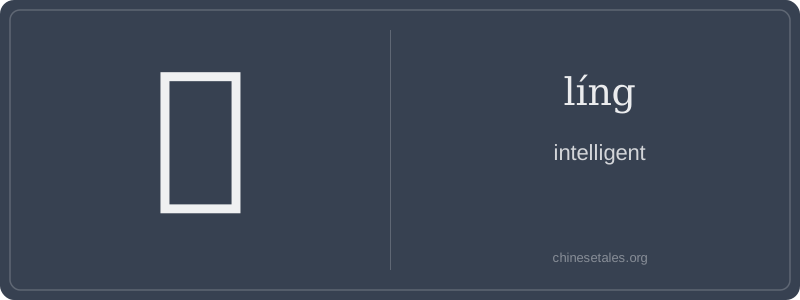
The character 姈 has no oracle bone or bronze script attestation — it’s a later creation, likely emerging during the Han dynasty as a semantic-phonetic compound. Its left side, 女 (nǚ, 'woman'), is the radical — not because intelligence is gendered, but because many characters denoting human qualities (especially refined or virtuous ones like 婉 wǎn 'graceful', 娴 xián 'refined') historically used 女 as a classifier for cultivated inner traits. The right side, 令 (lìng, 'to command; excellent'), provides both sound and meaning: in ancient usage, 令 also carried connotations of 'excellence' and 'admirable quality' — so 姈 literally 'fuses' the idea of a cultivated person (女) with excellence (令).
Over time, 姈 narrowed from its broader early sense of 'excellent, admirable' to specifically denote mental acuity. It appears in Tang dynasty poetry and Song dynasty essays praising scholars’ 'ling zhi' (líng zhī, 'perceptive insight'), often contrasted with mere erudition. Visually, the character’s balance — the soft curve of 女 anchoring the crisp, authoritative stroke of 令 — mirrors its meaning: intelligence grounded in grace and discernment, not force or noise.
At first glance, 姈 (líng) feels like a quiet powerhouse — it means 'intelligent', but not in the flashy, IQ-test sense. In Chinese, it evokes quick-wittedness, perceptiveness, and mental agility: the kind of sharpness that notices subtleties, grasps nuance instantly, and adapts thoughtfully — think of a scholar reading between the lines of a classical poem or a negotiator sensing unspoken tension. It’s warm, respectful intelligence — never arrogant.
Grammatically, 姈 is almost always used as an adjective before a noun (e.g., 姈人 líng rén — 'a quick-witted person') or in set phrases like 聪姈 (cōng líng), where it pairs with 聪 to amplify meaning. Crucially, it’s *not* used predicatively on its own — you wouldn’t say *'He is 姈'* without a noun or compound. Learners often mistakenly treat it like English 'intelligent' and try to use it bare, leading to unnatural phrasing. It thrives in compounds and descriptions, rarely standing alone.
Culturally, 姈 reflects a deep-rooted Confucian appreciation for *discernment* over raw knowledge — it’s about wisdom-in-action, not just book smarts. Interestingly, while common in literary and formal registers, it’s nearly absent from spoken Mandarin today; most native speakers encounter it mainly in classical texts or fixed expressions. That’s why it’s not in the HSK list — it’s elegant, archaic, and reserved, like wearing silk robes to a coffee shop: technically correct, but contextually rare.