姅
Character Story & Explanation
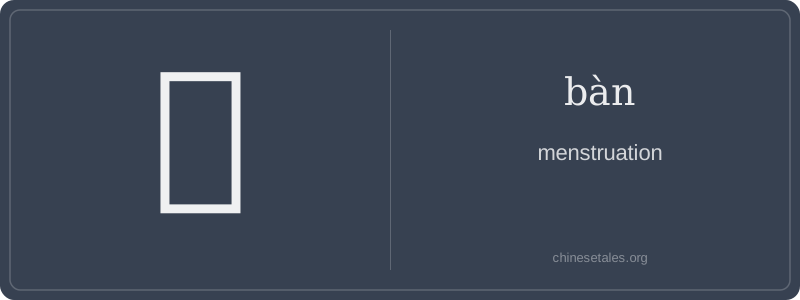
The earliest trace of 姅 appears not in oracle bones but in late Warring States bamboo slips and Han dynasty medical manuscripts — a deliberate fusion character, not a pictograph. It was constructed by combining 女 (nǚ, 'female') on the left — a stylized kneeling woman with emphasized pelvic curve — and 半 (bàn, 'half') on the right, originally depicting a split jade disc (a symbol of division and ritual balance). Over centuries, the 女 radical simplified from three strokes (including a pronounced curved line for the waist) into today’s compact two-stroke form, while 半 lost its top 'eight' component (八) and stabilized into its modern shape — making 姅 a purpose-built semantic-phonetic compound (形声字), where 女 signals meaning and 半 hints at pronunciation.
This character never appeared in the Shuōwén Jiězì (121 CE), China’s first dictionary — it emerged later in specialized medical texts like the Mawangdui silk manuscripts (c. 168 BCE), where it described menstrual patterns alongside lunar phases and pulse diagnosis. Its meaning stayed remarkably stable: not just bleeding, but the *regulated, natural halving* of female vitality — a concept deeply embedded in Daoist and Huangdi Neijing physiology. The visual pairing of 'female' + 'half' wasn’t metaphorical fluff; it encoded a diagnostic principle: imbalance arose when this 'half-cycle' became irregular, excessive, or absent.
Let’s be honest: 姅 (bàn) is a linguistic ghost — ancient, rare, and almost never spoken aloud in modern Mandarin. It means 'menstruation', but not in the clinical or colloquial way you’d expect. Think of it as the character equivalent of a faded ink seal on a Tang dynasty medical scroll: dignified, archaic, and reserved for classical texts or poetic euphemism. Its core feel isn’t biological urgency — it’s quiet physiological rhythm, tied to lunar cycles and traditional yin-yang theory. You won’t hear it in daily conversation; even native speakers may blink and ask, 'Wait — that’s a real character?'
Grammatically, 姅 functions exclusively as a noun and appears only in fixed literary or medical compounds — never alone in speech or informal writing. It doesn’t take aspect particles (了, 过), nor does it combine freely like common nouns. For example, you’d say 月姅 (yuè bàn) — 'monthly menstruation' — but never *我姅了 ('I menstruated'). Learners sometimes mistakenly treat it like a verb or try to use it in modern slang contexts, which instantly flags their sentence as anachronistic or jarringly scholarly.
Culturally, 姅 reflects how pre-modern Chinese medicine encoded bodily processes with cosmological precision: the left side 女 (nǚ, 'female') anchors gender and embodiment, while the right side 半 (bàn, 'half') evokes cyclical incompleteness — the body ‘halved’ by its monthly ebb. This isn’t shame or secrecy; it’s systemic observation. A common mistake? Confusing it with 半 (bàn) alone — forgetting the 女 radical makes all the difference between 'half' and 'menstrual half-cycle'. Use it only when quoting classical sources or composing classical-style poetry — otherwise, stick with 月经 (yùe jīng).