姁
Character Story & Explanation
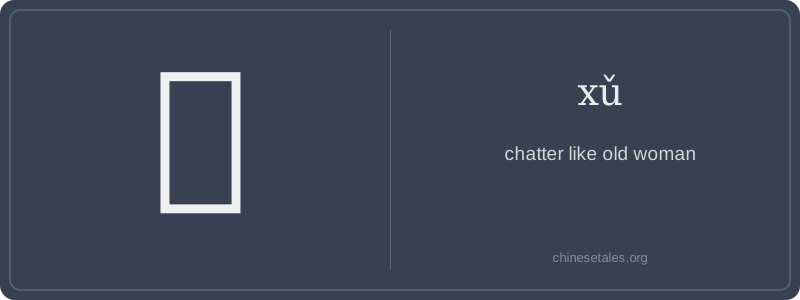
The earliest form of 姁 appears in Han dynasty seal script, not oracle bones — it’s a relatively late creation. Its left side is the 女 (nǚ, ‘woman’) radical, unmistakable even in ancient forms: three strokes suggesting hair, posture, and grace. The right side evolved from 可 (kě, ‘can/possible’), originally a pictograph of a mouth under a bent arm — symbolizing assent or approval. Over centuries, 可’s top stroke simplified, its vertical line straightened, and the two components fused into today’s balanced, symmetrical 姁: 女 + 可 = a woman whose speech carries gentle, affirming weight.
This visual fusion tells the story: a woman whose words aren’t commanding or sharp, but *reassuringly recurrent* — like a lullaby or blessing repeated until it settles into the listener’s bones. In the 12th-century *Jiè Zǐ Yuán Huà Zhuàn* (Mustard Seed Garden Manual of Painting), 姁 appears in commentary describing how to render ‘the serene, murmuring expression of maternal elders’ in figure painting. By the Ming dynasty, writers like Feng Menglong used 姁姁 to evoke the unflustered, unhurried speech of virtuous matriarchs — linking vocal rhythm to moral calm. The character doesn’t depict noise; it embodies *soothing continuity*.
First, let’s clear up a common misconception: 姁 (xǔ) isn’t just ‘chatter’ — it’s the *specific, rhythmic, affectionate chatter of an elderly woman*, often while doting on children or reminiscing. Think of a grandmother in a Beijing courtyard, voice soft but persistent, hands busy with embroidery, words flowing like warm tea — not idle gossip, but tender, repetitive, soothing speech. The feeling is gentle, slightly old-fashioned, and warmly intimate.
Grammatically, 姁 is almost always used reduplicatively as 姁姁 (xǔ xǔ), functioning as an adverb or adjective describing *how* someone speaks or behaves — never alone. You’ll see it in literary descriptions or poetic prose, e.g., ‘姁姁而语’ (speaking xǔ-xǔ), not in casual texting or HSK-level dialogues. It never takes objects, doesn’t pair with verbs like ‘say’ or ‘talk’ directly — it modifies the *manner*, like ‘softly’ or ‘tenderly’. Learners sometimes mistakenly treat it like a verb (‘she xǔs’) — but no: it’s always reduplicated and descriptive.
Culturally, 姁 carries nostalgic weight — it evokes pre-modern, domestic femininity: quiet authority, intergenerational care, oral tradition. You’ll find it in Qing dynasty fiction or modern essays about childhood memory — never in business emails or news headlines. A classic mistake? Confusing it with 许 (xǔ, ‘to permit’) because of identical pinyin — but their meanings, radicals, and usage worlds are galaxies apart. This character isn’t functional; it’s atmospheric — a brushstroke of tone and tenderness.