妺
Character Story & Explanation
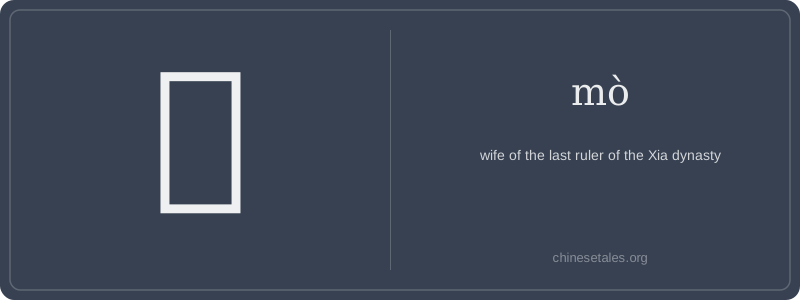
The earliest form of 妺 appears not in oracle bones—but in bronze inscriptions from the late Shang and early Zhou, where it was written as a variant of 喜, with the female radical 女 added on the left. Visually, it began as two components: 女 (a kneeling woman, later stylized into three strokes) on the left, and 喜 (a mouth 口 beneath a ‘drum’ 壴, representing joyous celebration) on the right. Over centuries, 喜 simplified—its top became 士, its bottom compressed—and the whole character gained a distinctive asymmetry: the 女 radical leans slightly left, while the right side swells with historical weight.
This visual duality mirrors its semantic journey: originally likely a phonetic-semantic compound (女 indicating gender category, 喜 suggesting pronunciation *xǐ*), it quickly ossified into a proper name. By the Han dynasty, Sima Qian’s Records of the Grand Historian treats 妺喜 as a fixed epithet—never dissected, never declined. Confucian moralists seized on her as a cautionary trope: beauty corrupting virtue. Yet the character itself remains neutral—no stroke hints at blame; its elegance belies its infamy. That tension—between serene script and scandalous story—is what makes 妺 unforgettable.
Imagine you’re reading a dusty bamboo-strip manuscript from the Warring States period, and suddenly—there it is: 妺, standing alone like a forgotten royal signature. This isn’t your everyday ‘sister’ or ‘wife’ character—it’s a proper noun with imperial gravitas: the name of the wife of Jie, the tyrannical last ruler of China’s legendary Xia dynasty (c. 2070–1600 BCE). In classical texts, 妺 appears only as part of her full title 妺喜 (Mòxǐ), never as a standalone noun meaning ‘wife’—so don’t try to say ‘my 妺’ or ‘her 妺’. It’s not a generic term; it’s a frozen historical name, like ‘Cleopatra’ in English: pronounceable, recognizable, but utterly non-productive.
Grammatically, 妺 functions exclusively as the first syllable of the compound 妺喜—never used independently in speech or modern writing. You’ll never see it in grammar drills, HSK lists, or even most dictionaries outside specialized historical or philological references. Learners sometimes misread it as mèi (‘younger sister’) due to the 女 radical and similar shape—but that’s a critical error: 妺 has zero connection to kinship terms. Its tone is fourth tone (mò), and its pronunciation is archaic, preserved only because ancient historians recorded it verbatim.
Culturally, 妺 embodies how Chinese writing preserves history like amber: not through narrative, but through fossilized names. She’s infamous in classical sources like the Bamboo Annals and Shiji as a symbol of decadence—blamed (unfairly, by modern scholars) for Jie’s downfall. But here’s the twist: no contemporary Xia inscriptions confirm her existence—she may be semi-legendary. So when you encounter 妺, you’re not just reading a character—you’re touching a 4,000-year-old historiographical debate, wrapped in ink and silence.