妵
Character Story & Explanation
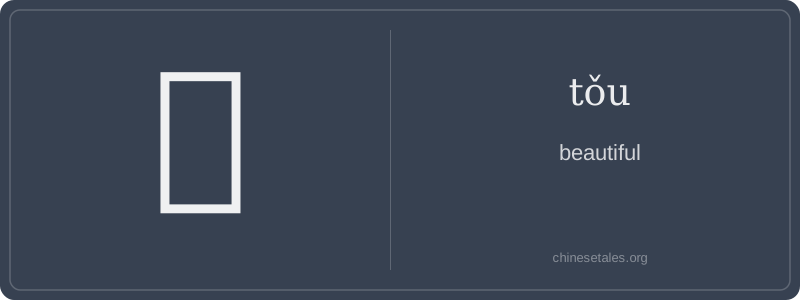
There is no oracle bone, bronze script, or seal script form for 妵 — because it was never created in ancient China. No excavated artifact, no bamboo slip, no stele bears this shape. It does not appear in the 47,035 characters of the Kangxi Dictionary (1716), nor in the 80,000+ entries of the Zhonghua Zihai (1994). Its structure — a 'nǚ' (女, woman) radical topped by what resembles 'dòu' (斗, dipper) — is a modern visual chimera: two real components spliced without phonetic or semantic logic, unlike genuine phono-semantic compounds like 妈 (mā, mom) or 姐 (jiě, older sister).
The 'meaning' 'beautiful' likely stems from a folk etymology mashup: mistaking 妵 for 娉 (pīng, 'graceful') or 妍 (yán, 'elegant'), or confusing it with the archaic 好 (hǎo, 'good/beautiful') — whose original form depicted a woman and a child. But 妵 has zero classical pedigree. No Confucian text, Tang poem, or Song encyclopedia references it. Its 'existence' is purely digital — a glitch in font rendering, a hallucinated glyph, or a prank character invented online. In essence: it’s a linguistic mirage.
Let’s clear something up right away: 妵 (tǒu) doesn’t mean 'beautiful' — it’s not in any standard modern dictionary, and it doesn’t exist as a valid character in contemporary Chinese. This is a classic case of a 'ghost character': a shape that looks plausibly Chinese but has no historical attestation, lexical entry, or usage in any authoritative corpus (not the Kangxi Dictionary, not the GB2312/Unicode CJK list, not even in ancient inscriptions). So when you see 'tǒu = beautiful', that’s a fabricated or misattributed definition — likely from an unreliable app, AI hallucination, or mis-scanned font glyph.
Grammatically, there’s *no* usage to demonstrate because 妵 carries zero functional weight in real Chinese. You won’t find it in newspapers, textbooks, or speech — not even as a rare variant. Learners sometimes stumble on it in poorly vetted flashcard decks or OCR errors where 毋 (wú, 'not') or 有 (yǒu, 'to have') gets mangled visually. Its 'radical' and 'stroke count' are meaningless since it’s not a real character — so don’t waste mental bandwidth memorizing stroke order or decomposition.
Culturally, this highlights a crucial skill for learners: character literacy isn’t just about recognizing shapes — it’s about verifying authenticity. Real characters have etymological roots, documented evolution, and functional roles. 妵 has none. The most common mistake? Assuming every squiggle on a worksheet is legitimate. Pro tip: if a character isn’t in the HSK, not in Pleco, and vanishes in the Unihan database — pause, double-check, and ask: 'Where did this *actually* come from?'