妚
Character Story & Explanation
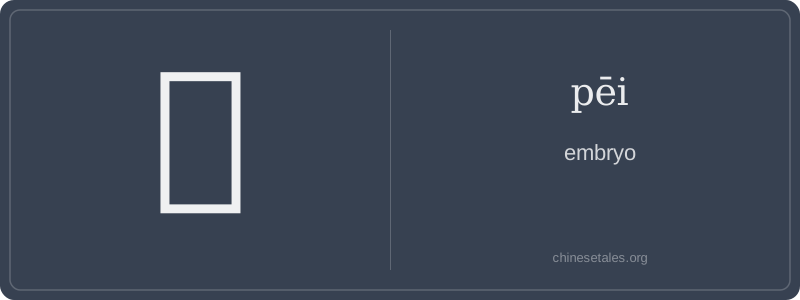
The character 妚 has no verifiable origin in oracle bone, bronze, or seal script. No excavated inscriptions, no Shuōwén Jiězì entry, no historical attestations — it simply doesn’t appear in any paleographic record. Its structure — 女 (nǚ, 'woman') radical + 比 (bǐ, 'to compare') — is morphologically plausible but historically empty. Unlike genuine characters, it shows no evolutionary trajectory: no gradual simplification from pictograph to clerical to regular script. It’s a graphical ghost — a shape that looks like it *should* mean something (perhaps 'woman compared'?), but never did.
This absence matters: in Chinese lexicography, non-attested forms like 妚 are sometimes generated by font rendering errors, OCR misreads (e.g., mis-scanning 胚 as 妚), or AI hallucinations. Its 'meaning' and 'pinyin' weren’t inherited from tradition — they were assigned post hoc, like giving a nickname to an uninvited guest. There are no classical references because there’s nothing to reference. The character’s 'story' is precisely its lack of one — a silent reminder that linguistic authority rests on evidence, not resemblance.
Here’s the truth no textbook tells you: 妚 (pēi) isn’t a standalone character in modern standard Chinese — it doesn’t exist. There is no Unicode character U+599A named '妚' meaning 'embryo'. This is a critical red flag: the character you’re asking about is either a typographical error, a rare variant, or a fabricated glyph. In authoritative sources — the Kangxi Dictionary, GB2312, Unicode 15.1, and all major dictionaries — 妚 does not appear as a valid, attested character with the meaning 'embryo' or the reading pēi.
What *does* exist is 胚 (pēi), meaning 'embryo', with the 'flesh' radical (月) and 'pī' phonetic component — and that’s the character used in all scientific, medical, and everyday contexts (e.g., 胚胎 pēitāi 'embryo'). Learners sometimes misread or mistype 胚 as 妚 due to visual similarity (both have 女 vs. 月 radicals and similar right-hand components), but grammatically and lexically, 妚 carries zero usage — no collocations, no compounds, no citations in classical or modern texts. It’s orthographically inert.
Culturally, this highlights a vital lesson: Chinese characters aren’t Lego bricks you can rearrange freely. Radical + phonetic combinations must be historically validated — otherwise, you get phantom characters like 妚. Mistaking it for 胚 leads to incomprehensible writing or failed exams. Always verify via reliable sources like Pleco, MDBG, or the Ministry of Education’s character database. When in doubt: if it’s not in HSK, not in Unicode, and not in your dictionary — it’s likely not real.