妗
Character Story & Explanation
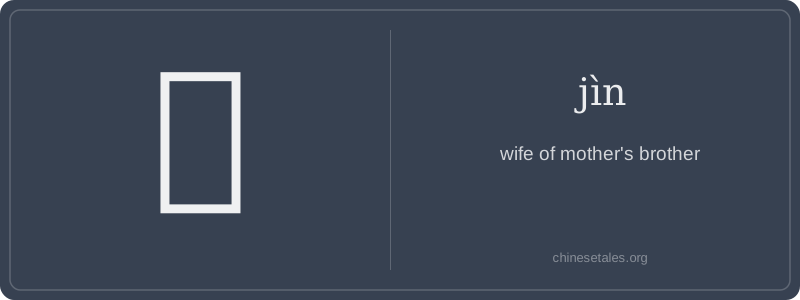
The earliest form of 妗 doesn’t survive in oracle bone script — it’s a later invention, likely emerging in the Warring States or Han period as kinship terminology became systematized. Visually, it’s a clear semantic-phonetic compound: the left side is 女 (nǚ, 'woman'), the radical anchoring all female-related characters; the right side is 今 (jīn, 'now') — serving purely as a phonetic hint (jìn is a close tonal variant of jīn). No pictorial origin here — no dancing woman or woven basket — just elegant linguistic engineering: 'woman' + 'sound of jīn' = 'mother’s brother’s wife'. Its seven strokes flow deliberately: three for 女 (with the slanted dot and hook), four for 今 (the horizontal, vertical, dot, and downward stroke).
The meaning stabilized early: in the Shuōwén Jiězì (121 CE), Xu Shen defines it plainly as 'mother’s brother’s wife', confirming its role in Confucian familial taxonomy. Unlike many kinship terms that shifted over time (e.g., 姑 once meant 'father’s sister' and 'husband’s mother'), 妗 stayed remarkably stable — a testament to how tightly maternal uncle marriages were codified. Its visual simplicity belies its social weight: each stroke quietly affirms that in traditional Chinese society, your mother’s brother wasn’t just 'Uncle Li' — he came with a wife who held distinct ritual and emotional responsibilities toward you.
妗 is a beautifully precise kinship term — not just 'aunt', but specifically the wife of your mother’s brother. It’s one of those quiet, elegant characters that reflects how deeply Chinese culture maps family relationships: every branch, every spouse, every generation gets its own word. Think of it as linguistic cartography — mapping blood and marriage with surgical accuracy. You’ll rarely hear 妗 in casual speech today (most people say 阿姨 or just 姨妈), but it’s alive in formal writing, genealogies, and rural speech — especially among older generations who still use classical kinship terms.
Grammatically, 妗 functions like a noun and almost always appears with a kinship prefix or demonstrative: 我妗 (my jìn), 他妗 (his jìn), or more formally, 姨妗 (yí jìn) — a respectful compound pairing it with 姨 (mother’s sister). Crucially, it never stands alone without context; saying just '妗' sounds abrupt or archaic, like saying 'the matron' instead of 'my aunt'. Learners often misplace it by using it for *father’s* brother’s wife (that’s 婶, shěn) — a classic mix-up that turns a warm family gathering into an accidental genealogical faux pas.
Culturally, 妗 carries soft authority — she’s often the keeper of maternal family stories, recipes, and unspoken rules. In southern China (especially Fujian and Guangdong), 妗 may appear in ancestral tablets or wedding invitations to honor maternal lineage. And here’s the kicker: though it’s only 7 strokes and looks simple, it’s absent from HSK because it’s too specialized — a reminder that fluency isn’t just about frequency, but about knowing *which* precise word opens the right door in someone’s family history.