妍
Character Story & Explanation
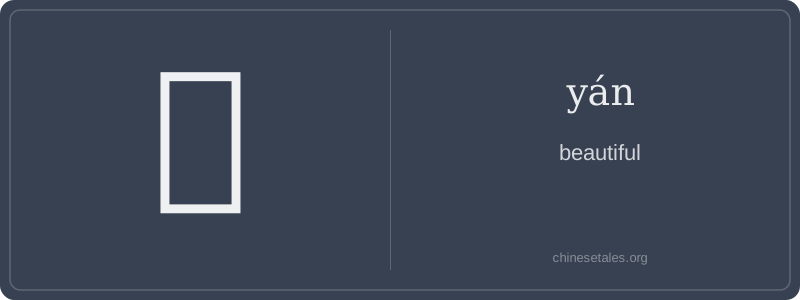
The earliest form of 妍 appears in seal script (around 200 BCE), built from two clear components: the radical 女 (nǚ, ‘woman’) on the left — signaling its semantic domain — and 言 (yán, ‘speech’, ‘words’) on the right, originally picturing a mouth and tongue. Crucially, 言 here isn’t about literal speaking — it’s a *phonetic loan*: its pronunciation (yán) was borrowed to indicate how 妍 should be read, while its visual presence subtly evokes ‘eloquence’ and ‘articulate grace’. Over centuries, the rounded seal-script forms sharpened into the clean, balanced structure we see today: three strokes for 女 (dot, hook, long slant), four for 言 (dot, horizontal, vertical, and the distinctive ‘roof-like’ top).
This fusion tells a quiet story: beauty that is *expressive*, even *persuasive* — not just seen, but felt through presence and poise. In classical texts like the *Wen Xuan* (Selections of Refined Literature), 妍 appears in phrases describing women whose charm lies in their refined demeanor and cultured speech — ‘言笑晏晏,容色甚妍’ (her laughter gentle, her countenance most graceful). The character’s shape itself mirrors this balance: the soft curve of 女 meets the structured clarity of 言 — elegance held in harmony.
At its heart, 妍 (yán) isn’t just ‘beautiful’ — it’s *elegant beauty with grace and refinement*, often carrying a poetic, almost classical weight. Think less ‘pretty selfie’ and more ‘a scholar’s ink painting of plum blossoms at dawn’. It’s rarely used alone in modern speech; you won’t hear someone say ‘她很妍’ — that sounds archaic or unnatural. Instead, 妍 lives in compound words like 妍丽 (yán lì, ‘exquisitely lovely’) or 姣妍 (jiāo yán, ‘delicately beautiful’), where it adds lyrical softness and aesthetic precision.
Grammatically, 妍 functions almost exclusively as a descriptive morpheme within adjectives or names — never as a verb or standalone predicate. Learners sometimes try to use it like 美 (měi) — e.g., *‘这个花很妍’ — but that’s a red flag: native speakers would say 这朵花很美 or very poetically, 这朵花姿容姣妍. Its presence signals literary register, so it appears far more often in poetry, classical allusions, or female given names (e.g., 慧妍, Yùyán) than in daily chat.
Culturally, 妍 subtly echoes Confucian ideals of feminine virtue — beauty that is harmonious, modest, and cultivated, not merely striking. A common mistake? Overusing it in writing hoping to sound ‘more Chinese’ — but doing so risks sounding stiff or unintentionally old-fashioned. Also, note: it’s almost always paired with another character — think of 妍 as the delicate second note in a duet, never the soloist.