妊
Character Story & Explanation
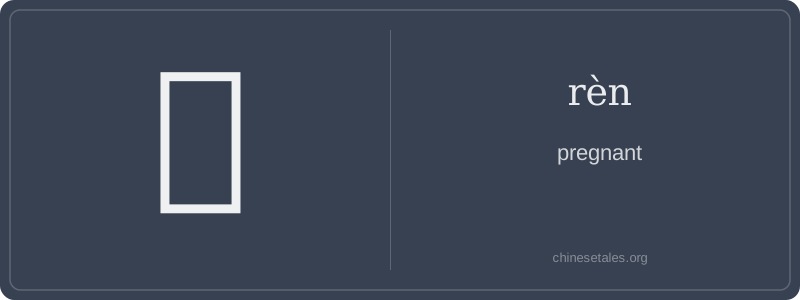
The earliest form of 妊 appears in seal script (c. 3rd century BCE), where it clearly combines 女 (a kneeling woman) with a simplified version of 任 — itself composed of 亻 (person) and 壬 (rén, an ancient pictograph of a heavy load). Over centuries, the 亻 merged visually into 口-like enclosure, and the lower part stabilized into 丷 + 一 — a stylized abstraction of burden-bearing. By the Han dynasty, the shape had crystallized into today’s seven-stroke form: the left 女 radical intact, the right side streamlined yet still echoing weight and containment.
This evolution mirrors its semantic journey: from 任 (rèn, 'to bear responsibility/weight') → 妊 (rèn, 'to bear a child'). In classical texts like the Huangdi Neijing (Yellow Emperor’s Inner Canon), 妊 appears in diagnostic contexts — not as a state, but as a physiological process: 'when the blood is abundant and the vessels are full, 妊 begins.' The visual fusion of 'woman' and 'bearing' makes it one of Chinese’s most elegantly literal characters — no metaphor needed, just anatomy and action fused in ink.
At its core, 妊 (rèn) isn’t just a clinical term for ‘pregnant’ — it’s a quiet, dignified word steeped in physiological awareness and classical restraint. Unlike the colloquial 孕 (yùn), which appears in everyday speech and even slang (e.g., 孕妇 yùnfù 'pregnant woman'), 妊 feels more literary or medical: you’ll see it in formal health pamphlets, obstetrics textbooks, or classical-style poetry describing gestation as a natural, almost sacred unfolding. It carries no emotional valence — no joy, no anxiety — just factual, embodied presence.
Grammatically, 妊 is almost never used alone. It’s strictly bound inside compounds like 妊娠 (rènshēn, 'pregnancy') or 妊妇 (rènfù, 'pregnant woman'). You’d never say *她妊了 — that’s ungrammatical and unnatural. Instead, it functions like a morpheme: silent on its own, powerful in combination. Learners often mistakenly treat it like a verb ('she is pregnant') — but it’s not; it’s a root that needs a partner to breathe.
Culturally, 妊 reflects how Chinese has long encoded bodily states through precise, character-based morphology rather than inflection. Its radical 女 (nǚ, 'woman') anchors it firmly in gendered experience, while the 口 (kǒu, 'mouth') + 丷 (bā, 'split') + 一 (yī, 'one') structure subtly evokes containment and emergence — a life held, then released. A common learner trap? Confusing it with 任 (rèn, 'to appoint') — same sound, totally different world. Pronounce it carefully: the tone is fourth (falling), not second (rising).