奸
Character Story & Explanation
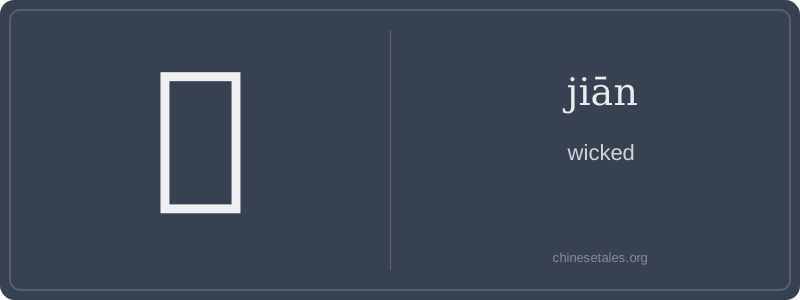
The earliest form of 奸 appears in Warring States bamboo slips as three stacked 女 (nǚ) radicals — ⚡️ — a striking visual triple-repetition emphasizing intensification: ‘woman + woman + woman’. This wasn’t literal polygamy, but a semantic amplifier — like stacking exclamation points — signaling extreme deviation from expected female virtue (as defined by patriarchal Zhou–Han ethics). Over time, scribes streamlined it: two 女 merged into one, and the third transformed into 干 (gān), both for phonetic approximation (*gān* sounding close to *jiān*) and symbolic reinforcement (干 means ‘to do, to act’, implying active wrongdoing). By the Han dynasty, the six-stroke structure 奸 was standardized — elegant, compact, and chillingly efficient.
This evolution mirrors a profound moral shift: from concrete social anxiety about women’s influence (seen in texts like the Book of Rites, warning against ‘women and small men’ being hard to manage) to abstract, gender-transcendent treachery. By the Tang, 奸 routinely described corrupt officials (not just women), and in the Ming novel Jin Ping Mei, it labels adulterous plots with clinical precision. The character’s visual economy — six strokes packing millennia of moral panic and linguistic refinement — makes it a masterclass in how Chinese script encodes ideology into ink.
Think of 奸 (jiān) as Chinese literature’s ‘villain glyph’ — not just ‘wicked’ in a vague sense, but the kind of calculated, morally slippery evil you’d find in a Shakespearean usurper or a Greek tragedy’s scheming oracle: deceitful, untrustworthy, and often sexually transgressive. Unlike English ‘evil’ (broad and metaphysical), 奪 carries visceral social weight — it implies betrayal of trust, violation of norms (especially familial or ethical), and deliberate moral corruption. It’s rarely used alone today; instead, it appears almost exclusively in compound nouns or formal/literary registers.
Grammatically, 奸 is strictly a noun or adjective within compounds — you’ll never say *‘tā hěn jiān’* (‘he is very wicked’) in modern speech; that sounds archaic or poetic. Instead, it’s embedded: 奸臣 (jiān chén, ‘treacherous minister’), 奸计 (jiān jì, ‘sinister scheme’). Learners mistakenly try to use it predicatively like 恶 (è) or 坏 (huài), leading to unnatural phrasing. Also, while 女 (nǚ, ‘woman’) is its radical, this isn’t about gender per se — it’s a historical artifact from ancient moral associations linking female-coded deception to social disorder (a problematic but persistent trope in pre-modern texts).
Culturally, 奸 evokes imperial court dramas and classical novels like Water Margin or Investiture of the Gods, where villains aren’t just cruel — they’re cunning, eloquent, and dangerously persuasive. Modern usage is mostly literary or journalistic (e.g., ‘奸商’ for ‘unscrupulous merchant’), and it’s conspicuously absent from daily conversation — which is why it’s not in the HSK. Overusing it makes your Mandarin sound like a Ming-dynasty morality play.