奰
Character Story & Explanation
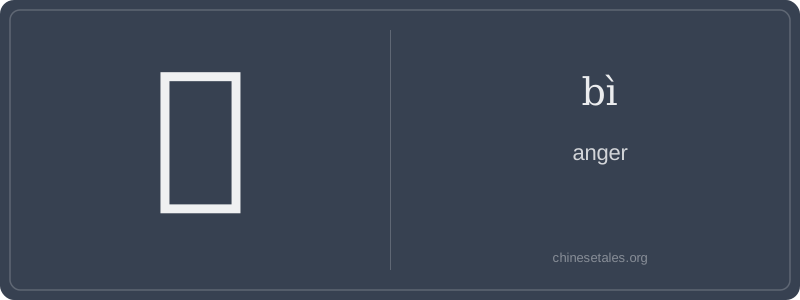
The earliest form of 奰 appears on Warring States bronze inscriptions—not as three dragons, but as three *boars* (豕) facing upward, stacked vertically inside a square enclosure. Each boar represented wild, untamable energy; stacking three amplified their ferocity into a primal, almost geological force. Over centuries, the boars morphed into stylized, dragon-like heads with exaggerated horns and open jaws, while the enclosing frame hardened into the ‘big’ (大) radical at the top and the ‘upright’ (山)–like base beneath. The modern character preserves that vertical triad: three identical components (three ‘fury-figures’) crowned by 大—visually shouting ‘MASSIVE ANGER!’
This evolution mirrors its semantic journey: from literal animal rage in early ritual texts (e.g., oracle bones invoking ancestral spirits to quell ‘奰祟’ — demonic wrath) to moralized cosmic fury in the *Book of Documents*, where Heaven’s 奰怒 justifies dynastic change. By the Tang dynasty, poets like Du Fu used 奰 to evoke nature’s violent grandeur—mountains seeming to ‘stand 奰然’ under storm clouds. Its visual weight—three identical elements screaming upward—makes it one of Chinese writing’s most visceral embodiments of accumulated, unstoppable emotion.
Think of 奰 (bì) as Chinese mythology’s version of the Hulk—except instead of green skin and ripped muscles, it’s three furious dragons stacked like a thunderous totem pole, roaring with collective wrath. This isn’t everyday anger (nǎo huǒ or fèn nù); it’s archaic, literary, and volcanic—reserved for cosmic indignation, historical injustice, or poetic fury so intense it shakes the heavens. You’ll almost never hear it in spoken Mandarin; it lives in classical texts, calligraphy scrolls, and the occasional solemn essay.
Grammatically, 奰 is almost always an adjective—never a verb—and appears only in fixed, highly stylized compounds like 奰怒 (bì nù) or 奰然 (bì rán). It doesn’t take aspect markers (了, 过), nor does it combine freely with modern modifiers: you can’t say *很奰 or *奰得很. Its power lies in its rigidity—it’s a fossilized intensity, not a flexible emotion word. Trying to use it like 恼火 is like quoting Shakespeare at a coffee shop: technically correct, but socially jarring.
Culturally, learners often misread 奰 as ‘strong’ or ‘powerful’—a dangerous oversimplification. In fact, its force is purely emotional and moral: Confucian texts use 奰 to describe Heaven’s righteous wrath against tyrants (e.g., ‘天奰不饗’ — ‘Heaven, enraged, refuses the sacrifice’). Mistaking it for neutral strength misses its ethical gravity. Also, because it contains no common radicals and looks intimidatingly complex, many assume it’s a rare variant of 怒—but it’s not related at all. It’s a linguistic relic, preserved not by utility, but by awe.