奭
Character Story & Explanation
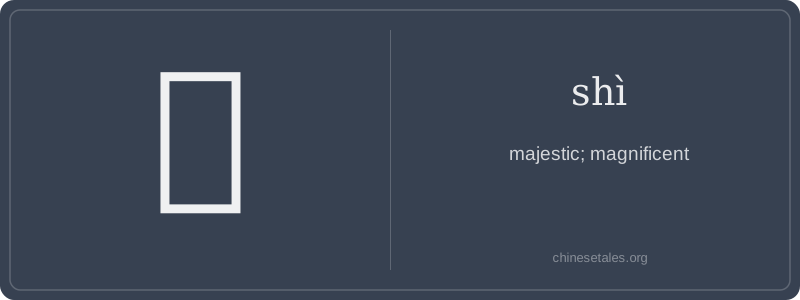
The earliest form of 奭 appears in late Shang oracle bone inscriptions as a pictograph combining two elements: a large human figure (大) standing upright, and above it, a stylized representation of a towering, multi-tiered ceremonial platform or altar—often rendered with stacked horizontal lines suggesting height and ritual elevation. Over centuries, the ‘platform’ simplified into the upper component (a variant of 亠 + 丷), while the lower 大 remained stable. By the Qin small seal script, the character had crystallized into its modern structure: a broad, symmetrical top pressing down over the expansive 大—visually embodying vertical authority and grounded magnitude.
This visual logic shaped its meaning: not mere size, but *hierarchically sanctioned grandeur*. In the Book of Documents, 奭 describes the sovereign’s virtuous presence—'his virtue is 奭' meaning his moral stature commands awe like a mountain. Later, in Han dynasty steles and Tang poetry, it became synonymous with architectural sublimity: Du Fu wrote of temples whose eaves rose 奭然—suddenly, overwhelmingly majestic—capturing both visual impact and spiritual weight. The character’s shape itself enacts its meaning: the top compresses space, the 大 expands it—a perfect tension of control and magnificence.
Imagine standing before the Hall of Supreme Harmony in Beijing’s Forbidden City at dawn—the golden roof blazing under the first light, the massive marble terrace stretching into mist, and the sheer scale making you instinctively hold your breath. That awe? That hushed reverence for overwhelming grandeur? That’s 奭 (shì). It’s not just 'big' or 'beautiful'; it’s the visceral weight of sacred majesty—reserved for imperial architecture, classical poetry, and cosmic order. You’ll rarely hear it in daily speech; it lives in literary Chinese, historical texts, and formal inscriptions.
Grammatically, 奭 is almost always an adjective, but unlike common adjectives like 美 (beautiful) or 大 (big), it never stands alone. It appears in fixed, elevated compounds like 奭大 (shì dà) or 奭然 (shì rán), and crucially—it’s never used predicatively ('This palace is 奭') without a modifier or context. Learners often mistakenly try to use it like 'impressive' in casual speech—e.g., 'That concert was 奭!'—but that sounds jarringly archaic, like calling a coffee 'majestic' in English. Instead, think of it as a ceremonial seal: only applied where tradition, scale, and solemnity converge.
Culturally, 奭 carries Confucian resonance—it implies moral and cosmic harmony embodied in form. Its rarity today makes it a linguistic artifact: when you see it carved on a temple beam or quoted in a Tang poem, you’re touching a 3,000-year-old aesthetic ideal. Mistake it for similar-sounding shì characters (like 是 or 世), and you’ll break syntax or meaning entirely—so pay attention to that radical: 大 (big) isn’t just decorative; it’s the anchor of its meaning.