奫
Character Story & Explanation
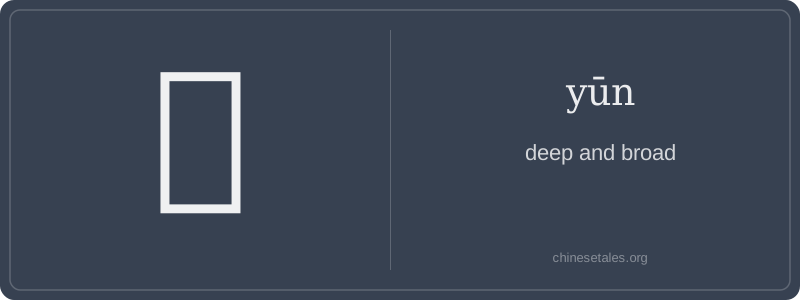
Originating in seal script (zhuànshū), 奫 was a masterclass in visual layering: it fused three components — the radical 氵 (water) on the left, and on the right, two stacked 'bends' (the top part resembles 旡, an ancient form meaning 'absence' or 'curved containment', later stylized into two wavy lines). Early inscriptions show water swirling *into* a double-folded basin — not just depth, but depth *within* depth, like nested whirlpools. Over centuries, the right side simplified from complex curves into the elegant, symmetrical double 'U'-like shape we see today: two mirrored arcs cradling emptiness — a graphic echo of boundless yet contained vastness.
This visual doubling shaped its meaning evolution: in the Shuōwén Jiězì (121 CE), Xu Shen defined it as 'water deep and wide', emphasizing simultaneity — not 'deep *or* broad', but deep *and* broad *as one quality*. By the Tang dynasty, poets like Li Bai used 奫 metaphorically: '星斗奫然' (xīng dǒu yūn rán) — 'the stars swirl in deep-broad radiance' — transforming celestial awe into linguistic geometry. Its form remains a silent lesson: true depth requires breadth; true breadth rests on depth.
At first glance, 奫 (yūn) feels like a quiet giant — it’s not flashy or frequent, but its meaning 'deep and broad' carries the weight of classical Chinese cosmology: depth isn’t just vertical distance, it’s moral gravity; breadth isn’t mere width, it’s inclusive wisdom. In Classical Chinese, it often described rivers, oceans, or even the Dao itself — not as physical spaces, but as metaphors for profound, unbounded understanding. You’ll rarely hear it in daily speech, but when you do — say, in poetic prose or scholarly commentary — it lands like a gong: resonant, deliberate, and slightly reverent.
Grammatically, 奫 is almost always an adjective, but unlike modern adjectives like 大 or 高, it doesn’t take 很 or 很~ structure. You won’t say *很奫* — that’s ungrammatical. Instead, it appears in literary compounds (e.g., 奫淵) or as a standalone descriptor in parallel, four-character phrases: '淵深奫廣' (yuan shēn yūn guǎng), where rhythm and symmetry matter more than syntax. Learners sometimes try to force it into conversational contexts ('This lake is so 奫!'), but native speakers would instinctively reach for 深 or 寬 instead — 奫 belongs to the realm of ink-brush aesthetics, not WeChat chats.
Culturally, 奫 reveals how Chinese values embed spatial metaphors with ethical resonance: deep water hides power, breadth suggests tolerance — together, they evoke the ideal sage: grounded yet expansive, still yet all-encompassing. A common mistake? Confusing it with 淵 (yuān, 'abyss') or 宛 (wǎn, 'graceful') — visually similar, semantically worlds apart. Its rarity means it’s not tested, but spotting it in Tang poetry or Song essays signals deep reading chops.