奣
Character Story & Explanation
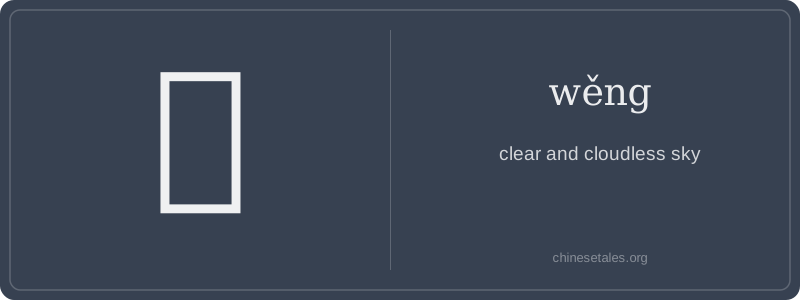
The character 奣 first appeared in seal script during the Warring States period — not as a pictograph, but as a carefully crafted semantic-phonetic compound. Its top component, 天 (tiān, 'sky'), anchors the meaning, while the bottom, 翁 (wēng, 'old man'), serves phonetically (both share the 'weng' sound root). Early forms show 天 clearly above a stylized, crouching figure with a long beard — the 'old man' element — later simplified into the modern 翁 shape. Crucially, there’s *no* cloud radical (冫 or 云); its clarity is defined by *absence*, not presence — a brilliant linguistic paradox.
This absence-as-meaning reflects Daoist and Chan Buddhist aesthetics: true clarity isn’t brightness added, but obstruction removed. In Tang dynasty poetry, 奣 appears in Du Fu’s lesser-known landscape fragments to describe skies so pure they feel weightless. By the Ming era, painters used 奣朗 to praise brushwork that achieved 'luminous emptiness' — where negative space itself seems radiant. Even today, calligraphers choose 奣 not for literal weather, but to evoke a mind unclouded by desire or distraction — making this 'sky' fundamentally interior as much as atmospheric.
Think of 奣 (wěng) as Chinese poetry’s equivalent of a perfectly framed Ansel Adams landscape — not just 'clear sky', but the hushed, luminous stillness *after* a storm has passed and the world holds its breath. It evokes a rare, almost sacred clarity: crisp air, infinite blue, no haze, no ambiguity — a visual and emotional state so specific that even native speakers reserve it for literary or artistic contexts, never daily weather reports. You’ll never hear someone say '今天很奣' over breakfast; instead, it appears in classical couplets, ink-painting inscriptions, or lyrical essays describing mountain vistas at dawn.
Grammatically, 奣 is almost always an adjective — but unlike common adjectives like 高 or 美, it rarely stands alone. It’s nearly always paired: 奣朗 (wěng lǎng), 奣澈 (wěng chè), or 奣然 (wěng rán). It can’t be modified by 很 or 非常 — saying *很奣* sounds jarringly modern and unpoetic, like putting a neon sign on a Song dynasty scroll. Its power lies in restraint: it’s used sparingly, often as the final, resonant note in a descriptive phrase.
Learners often mistakenly treat 奣 as a general synonym for 'clear' (like 清) and try to use it for water, glass, or logic — but 奣 applies *only* to atmospheric openness and luminous spaciousness. Confusing it with 清 (qīng) or 明 (míng) is like calling a cathedral 'bright' when you mean 'soaring'. Also, watch your tone: wěng (third tone) rhymes with 'ung' in 'lung' — not 'weng' as in 'sung'. Mispronouncing it as wēng or wèng risks sounding like you’re imitating a bee or clearing your throat!