奡
Character Story & Explanation
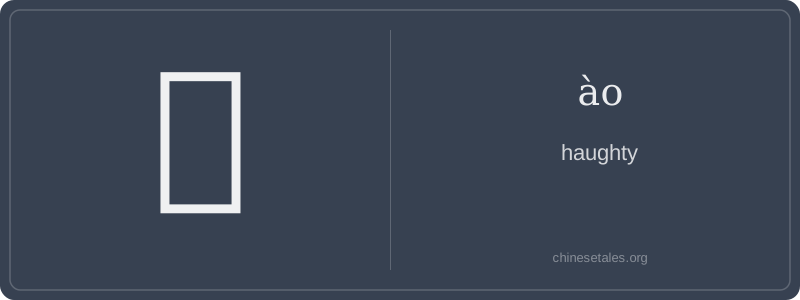
The character 奡 first appeared in bronze inscriptions of the late Zhou dynasty (c. 5th century BCE) as a complex pictograph: two interlocking arms above a kneeling figure, flanked by what scholars reconstruct as stylized mountain peaks or towering waves — suggesting immense, unyielding stature. Over centuries, the kneeling form simplified into the radical 大 (dà, ‘big’), while the upper element evolved from intertwined arms into the distinctive ‘two overlapping curves’ (丷 + 一 + 口-like shape), eventually crystallizing into today’s 12-stroke form. The radical is 大 — not a semantic classifier per se, but a visual anchor emphasizing scale and dominance.
This visual grandeur directly shaped its meaning: early texts like the Guoyu (Discourses of the States) used 奡 to describe legendary strongmen — notably the mythical giant Bo (伯) who could uproot trees and walk on water, whose strength was inseparable from his unbending pride. By the Tang dynasty, poets like Li Bai repurposed it metaphorically: ‘奡岸’ (ào àn) described cliffs *and* characters whose moral or artistic presence towered with intimidating self-possession. The character’s form — tall, angular, top-heavy — mirrors its semantic weight: it doesn’t just *mean* haughtiness; it *looks* like arrogance made visible.
Think of 奡 (ào) as the Chinese linguistic cousin of the word 'arrogant' — but with a distinctly mythological swagger. It doesn’t just mean ‘haughty’; it evokes towering pride, almost superhuman self-assurance — like a Greek god who’s *too* sure he’ll win the chariot race. In classical and literary usage, it describes not petty snobbery but an overwhelming, almost physical aura of superiority — imagine Dorian Gray’s portrait whispering disdain, or Thanos snapping his fingers while sighing at mortal frailty.
Grammatically, 奡 is almost never used alone in modern speech; it’s strictly a literary adjective, always appearing in compounds (like 奡慢 or 奡然) or poetic phrases. You won’t hear it in casual conversation — no one says ‘他很奡’ — but you *will* see it in essays, historical novels, or formal critiques: ‘其文奡岸’ (his writing is haughtily majestic). Learners mistakenly treat it like common adjectives (e.g., trying to say ‘ào de rén’), but it resists that pattern — it’s syntactically stubborn, clinging to classical structures and fixed collocations.
Culturally, 奡 carries a subtle moral weight: Confucian texts often pair it with warnings — haughtiness isn’t just rude; it’s a sign of spiritual imbalance, a crack in the virtue of humility (谦). Mistaking it for neutral ‘confident’ is a classic trap: 奡 implies *disdainful* confidence, the kind that alienates rather than inspires. And crucially — despite its 12 strokes, it’s *not* in any HSK list, meaning textbooks ignore it entirely. You’ll only meet it when reading Tang poetry or Ming dynasty satire… or this very entry.