奜
Character Story & Explanation
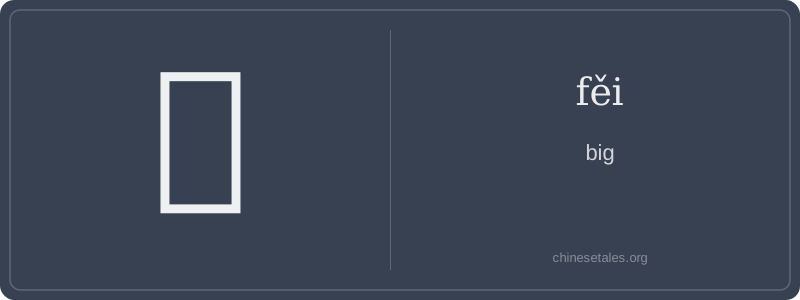
Carved onto Shang dynasty oracle bones over 3,000 years ago, the earliest form of 奜 looked like two towering peaks flanking a central ‘person’ (亻) — not literally human, but a symbolic axis representing the center of the cosmos. Over centuries, the peaks simplified into the top ‘非’ (fēi, ‘not’), while the person radical settled firmly on the left. Crucially, ‘非’ here isn’t semantic negation — it’s purely phonetic and visual mimicry of twin mountain silhouettes. By the Han dynasty, the structure solidified: 亻+非, with the ‘non-human’ symmetry emphasizing scale beyond measure.
This character didn’t mean ‘big’ in the everyday sense — it meant ‘cosmically oversized’: the kind of bigness that defied normal categories. In the *Zuo Zhuan*, it described a feudal lord’s domain as 奜然不可侵 (fěi rán bù kě qīn — ‘so vast it could not be invaded’). Its visual duality — two mirrored sides framing a human — reinforced the idea that true magnitude isn’t solitary, but relational: big *in contrast to* human scale, big *because of* balance, big *as a force of order*.
Here’s the truth no textbook tells you: 奜 (fěi) isn’t just ‘big’ — it’s *archaic, poetic, and visually explosive*. It evokes overwhelming scale: mountains cracking the sky, rivers swelling beyond banks, or a ruler’s authority so vast it bends reality. Unlike common synonyms like 大 (dà) or 巨 (jù), 奜 carries literary weight — think classical poetry or historical inscriptions, not grocery lists. You’ll almost never hear it in spoken Mandarin today; it lives in written elegance, often paired with nouns suggesting grandeur (e.g., 奜然, 奜大). Learners mistakenly try to use it conversationally — but native speakers would blink, then gently correct you with 大 or 宏.
Grammatically, 奜 functions as an adjective, usually before a noun (奜然山势), or in fixed adverbial compounds like 奜然 (fěi rán — ‘impressively, massively’). It cannot stand alone as a predicate (*‘This is 奜’ is ungrammatical*); instead, it modifies — always intensifying, never neutral. Its tone (fěi, third) also hints at its rarity: that falling-rising contour feels like a deliberate pause before something monumental.
Culturally, 奜 whispers of ancient cosmology — where size wasn’t just physical, but moral and cosmic. Confucian texts used it to describe virtue so vast it reshaped society. Modern learners trip by overestimating its frequency (it’s absent from HSK, newspapers, and even most literature after the Tang dynasty). The real trick? Treat 奜 like a rare spice: one pinch in a poem, never in soup.