奚
Character Story & Explanation
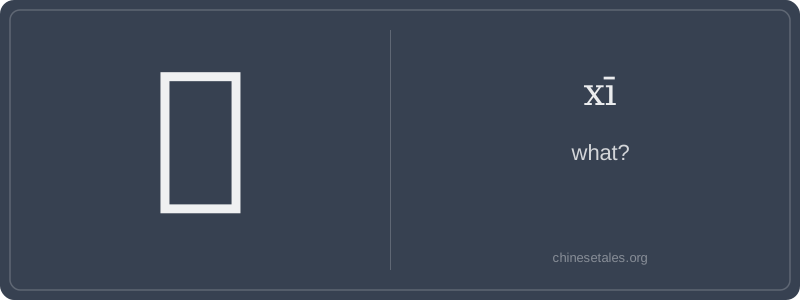
Trace back to Shang dynasty oracle bones, and 奚 began as a vivid pictograph: a kneeling figure (the bent legs and torso) with hands tied behind the back — unmistakably a captured servant or slave. Over centuries, the ropes morphed into the top component (幺, yāo, meaning 'tiny threads'), while the kneeling posture solidified into the lower part, eventually stylized into the radical 大 (dà) — not 'big' per se, but a simplified representation of a human form in submission. By the Warring States period, the character had shed its literal slave connotation and taken on a grammatical life: because slaves were nameless, faceless, 'unspecified persons', 奚 naturally evolved to ask 'which one?' or 'what thing?'
This semantic pivot is brilliant: from depicting an anonymous captive to becoming the go-to word for indefiniteness and interrogation. In the *Analects*, Confucius uses 奚 in rhetorical flourishes like 奚不亦乐乎?('Why not be joyful too?'), where the character adds elegance and distance. Even today, its shape echoes that ancient kneeling posture — look closely: the three short strokes at the top (幺) are the bonds, the 大 below is the bowed body — a ten-stroke monument to how grammar grows from social reality.
At first glance, 奚 (xī) feels like a ghost from classical Chinese — it’s rarely used alone in modern speech, yet pulses with ancient energy. Its core meaning is 'what?' or 'which?', but not the everyday kind you’d use at a restaurant; think of it as the philosophical, poetic, or rhetorical 'what?' — the kind Confucius might pause on before answering a disciple. It carries weight, irony, or even gentle mockery: 'What on earth is this?' rather than 'What is this?'
Grammatically, 奚 almost never stands solo. It appears bound to other particles: most famously in 奚以 (xī yǐ) — 'with what?' or 'for what purpose?', as in 奚以知之?(xī yǐ zhī zhī?) 'By what means do you know this?' It also shows up in fixed literary phrases like 奚为 (xī wéi) — 'why?' — and occasionally in names or surnames (e.g., the historical Xī family). Learners often misread it as a common interrogative like 什么 (shénme), but that’s a critical error: 奚 isn’t conversational — it’s ceremonial, textual, and stylistically marked.
Culturally, 奚 whispers of antiquity: it’s one of the earliest interrogative pronouns in bronze inscriptions and appears over 30 times in the *Zuo Zhuan*, always with gravitas. A classic pitfall? Confusing its radical 大 (dà, 'big') with the character’s meaning — no, it doesn’t mean 'big what'; the 'big' is structural scaffolding, not semantic. Also, don’t try to force it into modern questions — your teacher won’t say 奚是你的名字?; they’ll say 你叫什么?