奘
Character Story & Explanation
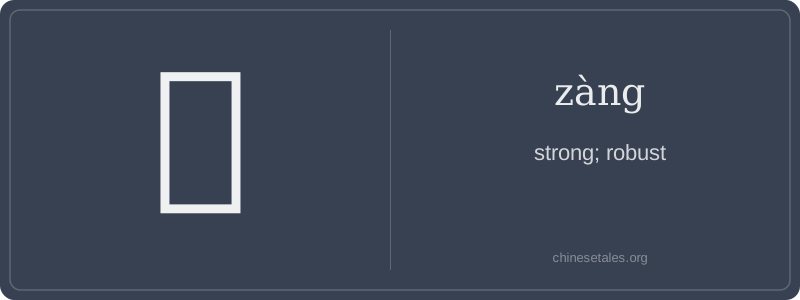
The earliest form of 奘 traces back to late Warring States bronze inscriptions, where it appeared as a compound pictograph: a large figure (大) standing beside two vertical strokes representing split timber (爿), later simplified into the top-heavy 藏-like component. Over centuries, the timber element morphed — the two vertical lines fused into a single stroke, the crossbar softened, and the lower part stabilized into the modern 藏-derived shape — all while preserving the visual impression of a strong person rooted beside solid, load-bearing wood. By the Han dynasty, clerical script had fully standardized the ten-stroke structure we use today: three strokes for 大, seven for the right-hand component.
This evolution mirrors its semantic journey: from a concrete depiction of physical sturdiness (a man built like a timber frame) to an abstract ideal of enduring strength — not brute force, but grounded, reliable power. In the Shuōwén Jiězì (121 CE), Xu Shen defines it as ‘strong-bodied, firm in conduct’ (體強而行堅), linking bodily robustness to moral constancy. The character even appears in early Buddhist sutra translations to describe monks whose ascetic practice forged unshakable physiques and wills — a resonance that lives on in Xuanzang’s name, where 奘 silently honors his legendary stamina crossing the Taklamakan desert.
At first glance, 奘 (zàng) feels like a muscular cousin of 大 (dà, 'big') — and that’s no accident. Its radical is 大, anchoring it firmly in the semantic field of size, strength, and physical presence. The right side, zàng, isn’t just phonetic decoration: it’s a stylized rendering of 爿 (pán), an ancient character meaning 'split wood' or 'split log', evoking solidity, resilience, and structural integrity — think of a stout timber beam holding up a roof. Together, they don’t mean ‘big’ alone, but ‘big *in substance*’: robust, powerfully built, unyielding in constitution.
Grammatically, 奘 is almost exclusively used as an adjective before nouns — never standalone, rarely predicative. You won’t say ‘He is 奘’; you’ll say ‘a 奘 man’ (奘汉). It’s also heavily regional: common in Northern Mandarin dialects (especially Shandong, Hebei) and literary registers, but virtually absent from modern standard written Chinese or spoken Putonghua outside fixed phrases. Learners often misread it as zhuǎng (like 撞) — a tempting slip, since both sounds imply force — but zhuǎng is colloquial for ‘to bump’ or ‘clumsy energy’, while zàng carries dignified heft. Mispronouncing it risks sounding like you’re describing someone as ‘bumping’ rather than ‘stalwart’.
Culturally, 奘 breathes with classical weight: it appears in Tang dynasty texts describing warriors and monks whose bodies bore the discipline of years — not just muscle, but moral and physical fortitude. Today, it survives most vividly in names (e.g., the famed monk Xuanzang, whose name uses the homophone 玄奘, where 奘 is deliberately chosen for its connotation of spiritual and physical endurance). Learners often skip it entirely — but mastering 奘 unlocks a richer layer of descriptive nuance, especially when reading historical fiction or regional literature.