奕
Character Story & Explanation
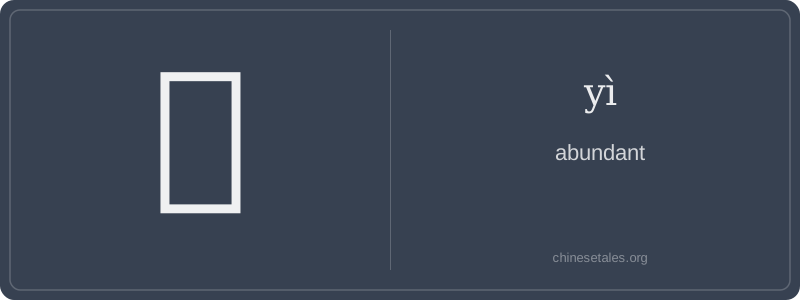
Carved on Shang dynasty oracle bones over 3,000 years ago, 奕 began as a vivid pictograph: two wide-open eyes (目 mù) stacked above a person (大 dà), suggesting someone gazing with extraordinary alertness and presence. Over centuries, the eyes simplified into two horizontal strokes (⺌), fused with the head and shoulders of 大, while the lower part solidified into the stable, expansive 'big' radical—visually anchoring that sense of abundant, grounded awareness. By the seal script era, the nine strokes had crystallized into today’s elegant balance: three strokes for the 'eyes' motif atop six for the 'great person' frame.
This visual origin directly shaped its meaning: not mere quantity, but *luminous abundance of spirit*. In the Book of Songs (Shījīng), it appears in '奕奕寢廟' (yì yì qǐn miào)—'the ancestral halls shine abundantly', evoking awe-inspiring grandeur. Later, Mencius used it to describe the 'abundant moral radiance' of a sage. Even today, when parents name a child Yì, they’re invoking that ancient ideal: not just 'successful', but luminously, unshakeably present.
At its heart, 奕 (yì) evokes abundance—not of rice or gold, but of *presence*: radiant, dignified, overflowing vitality. Think of a noble elder seated with effortless grace, their aura so rich it seems to shimmer—this is the 'abundant' quality 奕 captures. It’s not a quantifiable 'a lot' like 多 (duō), but a qualitative fullness: abundant dignity, abundant brilliance, abundant spirit. You’ll almost never see 奕 alone in modern speech; it lives exclusively in classical compounds and literary names.
Grammatically, 奕 functions as an adjective—always paired, never standalone. You won’t say 'this room is 奕'; you’ll say 光奕奕 (guāng yì yì) — 'shining abundantly', or 神采奕奕 (shén cǎi yì yì) — 'spirit shining abundantly'. Notice the reduplication pattern: yì yì signals intensification, like a gentle echo amplifying the richness. Learners often misread it as 'easy' (易 yì) or try to use it like a verb—big no-no. It’s a fossilized literary gem, not a working verb or noun.
Culturally, 奕 carries Confucian elegance—it appears in ancestral temple inscriptions, classical poetry praising virtuous rulers, and personal names (e.g., the Ming dynasty scholar Zhu Yì). Its rarity in daily speech makes it feel ceremonial, even sacred. A common trap? Assuming it means 'to be prosperous'—nope. It describes *how* something shines, not *that* it succeeds. Misplacing it can make your sentence sound like a Song dynasty eulogy instead of a WeChat message!