奄
Character Story & Explanation
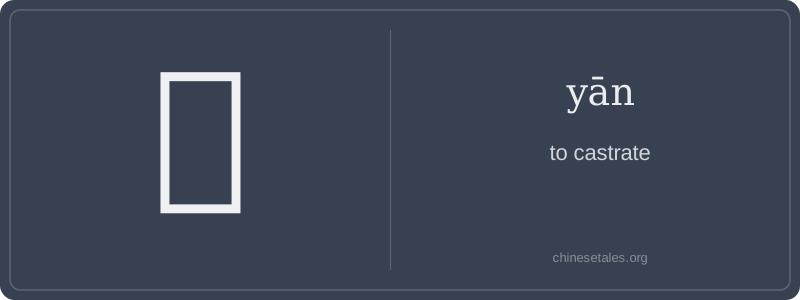
The earliest form of 奄 in oracle bone script (c. 1200 BCE) shows a kneeling person (大-like figure) with a sharp, downward stroke cutting across the lower torso — unmistakably depicting the act of castration. Over centuries, the kneeling posture simplified into the 大 radical, while the slashing line evolved into the three-stroke component above: 亠 + 丷 — originally representing a blade descending onto the body. By the seal script era, the shape had stabilized into today’s eight-stroke form: 大 crowned by a compact, angular top that visually mimics a decisive, irreversible cut.
This visceral origin explains why 奄 never softened into abstract usage — unlike many characters that drifted from concrete to metaphorical meanings, 奄 held fast to its somatic gravity. In the Zuo Zhuan, it appears in contexts describing punitive emasculation of rebels; by the Han dynasty, it became embedded in bureaucratic terms like 奄人 (eunuch-official). Even its secondary meaning 'faint/dying' (yǎn) stems from the same root idea: a life-altering, point-of-no-return moment — whether surgical or physiological. The character doesn’t just describe an action; it freezes the instant of irrevocable change.
At first glance, 奄 (yān) feels like a quiet, almost ghostly character — and that’s no accident. Its core meaning is 'to castrate', but it’s not used in everyday speech at all; instead, it survives almost exclusively in classical texts, historical terminology, and compound words related to eunuchs or ritual emasculation. The character carries strong connotations of power, control, and bodily transformation — think imperial court politics, not biology class. It’s never used as a verb in modern spoken Mandarin, so don’t try saying 'wǒ yān le tā' — that sentence simply doesn’t exist.
Grammatically, 奄 appears only in fixed compounds (like 奄人 or 奄寺) or as part of literary adjectives meaning 'sudden', 'faint', or 'dying' — yes, that’s the other pronunciation: yǎn! In this reading (e.g., 奄奄一息 yǎn yǎn yī xī), it evokes fading breath, near-death stillness — a semantic echo of its original sense of irreversible physical alteration. Learners often misread 奄 as 大 (dà) plus 电 (diàn) or confuse it with 掩 (yǎn, 'to cover'), but it has zero relation to electricity or concealment.
Culturally, 奄 is a linguistic time capsule: it preserves the brutal reality of eunuch systems in pre-modern China, where castration was both punishment and pathway to palace influence. Modern readers rarely encounter it outside history books or period dramas — which makes mixing it up with similar-looking characters especially risky. Pronounce it wrong (yān vs. yǎn), and you’ll shift from ‘castrated official’ to ‘barely breathing patient’ — two very different kinds of vulnerability.