夼
Character Story & Explanation
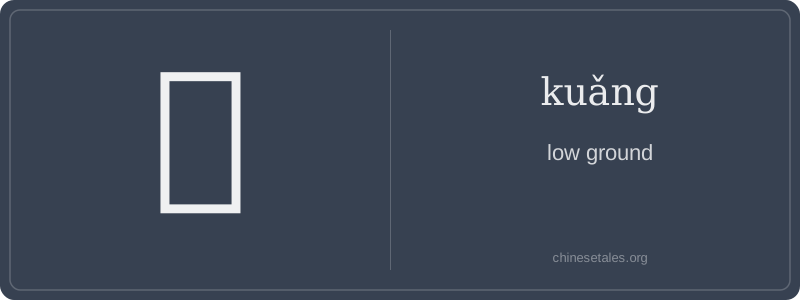
The earliest form of 夼 appears in bronze inscriptions of the late Shang and early Zhou dynasties as a pictograph resembling a wide, shallow basin nestled between two gentle slopes — drawn with three key strokes: a broad horizontal base (ground), two downward-curving lines on either side (contour edges), and a centered dot or short vertical (indicating depression or moisture). Over centuries, the contours simplified into the left and right 'legs' we see today, while the base evolved into the 大 radical — not because it means 'big', but because its open, grounded shape visually echoed the broad, flat-bottomed hollow it represented.
By the Warring States period, 夼 was already used in bamboo-slip texts to denote floodplains and alluvial basins — places that were agriculturally rich but vulnerable to seasonal inundation. The *Book of Documents* (*Shūjīng*) references ‘夼澤之交’ (the confluence of lowlands and marshes) when describing Yu the Great’s flood control work. Intriguingly, its visual structure — 大 (a person with outstretched arms) cradling emptiness — became a metaphor in Daoist-influenced commentary for yielding receptivity: true strength lies not in height, but in the capacity to hold what flows downward.
At first glance, 夼 (kuǎng) feels like a quiet, almost forgotten character — it’s not in the HSK, rarely appears in modern textbooks, and even many native speakers pause before recalling its meaning: 'low-lying land', especially damp or marshy ground near rivers or valleys. Its core vibe is geographical humility — not mountainous grandeur, but the gentle, water-softened hollows where reeds grow and mist settles at dawn. It carries no emotional charge, just quiet topographic precision.
Grammatically, 夼 functions exclusively as a noun, never as a verb or adjective, and almost never stands alone. You’ll only encounter it embedded in classical compounds or place names (like ancient river basin terms), often paired with characters like 泽 (zé, marsh), 壑 (hè, ravine), or 野 (yě, field). For example, in the phrase ‘洿夼’ (wū kuǎng), it means ‘sunken marshland’ — notice how the ‘wū’ (dirty/low) reinforces the downward, watery connotation. Learners mistakenly try to use it like 地 (dì, ground) or 坑 (kēng, pit), but 夼 implies natural, broad, gently depressed terrain — not a dug hole or generic surface.
Culturally, 夼 survives mostly in historical geography texts and poetic descriptions of pre-modern landscapes — think Tang dynasty travel essays or Song-era local gazetteers. It’s a lexical fossil reminding us how precisely Classical Chinese mapped micro-terrain. A common learner trap? Pronouncing it as ‘kuāng’ (like 匡) or confusing it with 水 (shuǐ) due to the ‘water-adjacent’ feel — but there’s no water radical here! Its radical is 大 (dà, big), which ironically contrasts with its meaning: this ‘big’ radical frames something low — a subtle linguistic wink at perspective and relativity in landscape.