夷
Character Story & Explanation
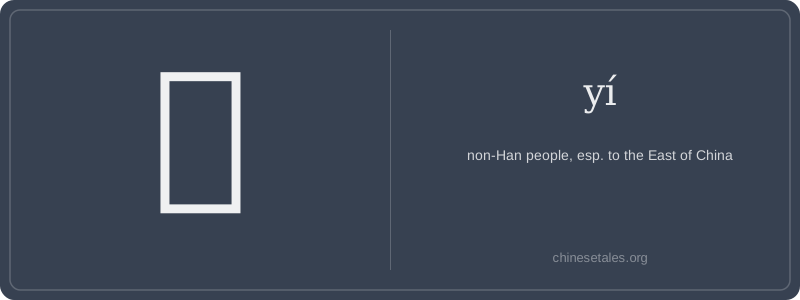
The earliest form of 夷 appears in Shang oracle bones as a striking pictograph: a kneeling person (大, ‘big’ or ‘person’) with a large bow (弓) beside them — sometimes even with an arrow drawn. Over centuries, the bow simplified into the two horizontal strokes above 大, and the kneeling posture fused into the clean, open stance of modern 夷. By the Warring States period, the bow had vanished entirely from the script, leaving only the ‘person’ radical 大 plus two level strokes — a brilliant visual shorthand: ‘a person who stands flat-footed, barefoot, and bows low’ — echoing how Eastern tribes were stereotyped in Zhou-era records.
This bow-and-kneel origin explains why 夷 wasn’t just ‘foreigner’ but specifically ‘eastern non-Zhou people’ — distinct from 西戎 (Xī Róng, Western Rong), 南蠻 (Nán Mán, Southern Man), and 北狄 (Běi Dí, Northern Di). In the Book of Documents (Shūjīng), 夷 appears in ‘The Pacification of the Eastern Yi’ — describing diplomatic missions, not conquests. Intriguingly, the same character later lent its shape to 夷 (yí) meaning ‘to level’ or ‘to flatten’ (a homophone), creating a subtle pun: ‘to pacify the Eastern Yi’ literally meant ‘to level their resistance’ — a linguistic double-meaning that shaped political rhetoric for centuries.
Think of 夷 (yí) as China’s ancient version of the ‘barbarian’ label — but with a twist: unlike the Greek ‘barbaros’ (which mocked foreign speech as ‘bar-bar’), 夷 wasn’t originally about incomprehensibility. It was geographic and visual: ‘people to the east’, often depicted in early texts as bow-wielding, tattooed, or barefoot. The character feels archaic and literary — you won’t hear it in daily conversation like 朋友 or 老师, but you’ll spot it in historical novels, classical poetry, or academic writing on ethnic relations.
Grammatically, 夷 functions almost exclusively as a noun (‘Eastern peoples’) or in compound nouns — never as a verb or adjective on its own. Learners sometimes mistakenly use it like 異 (yì, ‘different’) or try to pluralize it (e.g., *yís*), but it’s always singular and uncountable in classical usage. You’ll see it in fixed terms like 東夷 (Dōng Yí, ‘Eastern Yi’) or in poetic compounds like 夷歌 (Yí gē, ‘songs of the eastern peoples’), where it evokes cultural distance, not hostility.
Culturally, 夷 carries layered weight: while Confucius used it neutrally (e.g., ‘The Yi and Di have rulers but no rites’ — Analects 3.5), later dynasties weaponized it to justify assimilation. Today, scholars avoid 夷 alone when referring to ethnic groups (preferring modern terms like 少数民族), making it a linguistic time capsule — best understood as a respectful, critical reading of history, not a descriptor for living people.