夥
Character Story & Explanation
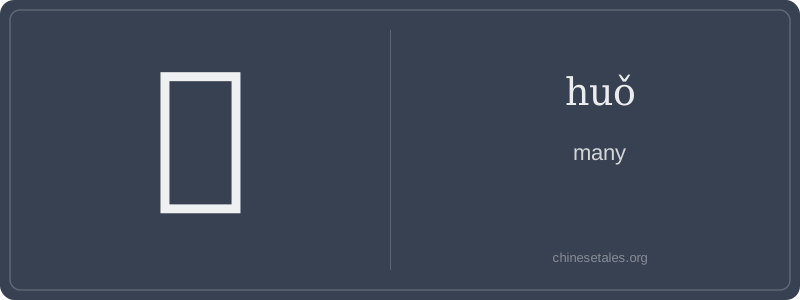
The earliest form of 夥 appears in bronze inscriptions as two facing 'person' radicals (亻) beside a 'fire' (火) — not the modern 夕 radical! That original shape () depicted two people gathered around a central fire — a primal image of community, shared warmth, and collective life. Over centuries, the two 亻 merged visually and simplified; the central 火 gradually distorted under clerical script pressure until scribes misread its top as 夕 (‘evening’), which became the official radical by the Kangxi Dictionary era — a classic case of ‘ghost radical’: the current radical doesn’t reflect meaning or origin, but scribal accident.
This visual shift didn’t erase the meaning — quite the opposite. The fire-and-people motif anchored its semantic core: not mere numerical plurality, but *social multiplicity*. In the *Zuo Zhuan*, 夥 appears in phrases like *bīng huǒ* (troops numerous), emphasizing coordinated human force. By the Song dynasty, poets used *rén huǒ* to contrast urban bustle with mountain solitude. Even today, when writers choose 夥 over 多, they’re invoking that ancient ember — not just 'many', but 'many *together*', echoing the crackle of that first shared flame.
At first glance, 夥 (huǒ) feels like a quiet rebel — it means 'many' or 'numerous', but it’s almost never used alone in modern Mandarin. Unlike the everyday 多 (duō), 夥 carries an old-fashioned, literary, or even slightly rustic flavor, like finding a hand-carved wooden spoon in a kitchen full of plastic. Its core sense is abundance — not just quantity, but collective presence: a crowd, a throng, a bustling assembly. You’ll spot it mostly in fixed compounds or classical allusions, rarely as a free-standing adjective.
Grammatically, 夥 doesn’t behave like a typical descriptive word. It doesn’t take degree adverbs (e.g., *hěn huǒ* is ungrammatical), nor does it modify nouns directly without support — you won’t say *huǒ rén*, but rather *rén huǒ* (people numerous → 'a great many people') or in set phrases like *rén huǒ chōng tiān* ('people and fire fill the sky' — i.e., extremely lively). Learners often mistakenly treat it like 多 and try to slot it into colloquial sentences — a subtle error that makes speech sound oddly archaic or poetic, like quoting Tang dynasty poetry at a coffee shop.
Culturally, 夥 evokes communal energy: markets teeming with vendors, temple fairs overflowing with pilgrims, or revolutionary slogans from early 20th-century posters shouting *qún zhòng huǒ rè* ('the masses are fervent'). It’s not neutral abundance — it’s warm, human, kinetic. And yes, it’s absent from the HSK lists for good reason: it’s a character you’ll read more than speak, like encountering a well-preserved Ming vase — beautiful, meaningful, but not for daily use.