夤
Character Story & Explanation
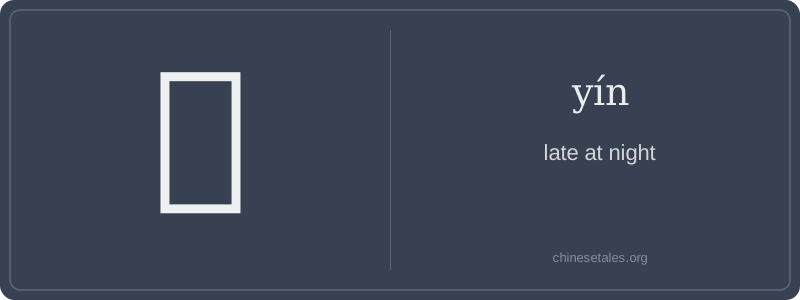
The earliest form of 夤 appears in bronze inscriptions as a complex ideograph: at its heart stood 夕 (xī, 'sunset'), but flanked by two stylized 'hands' (爫-like components) holding up a curved line representing the arc of the night sky — visualizing humans vigilantly supporting the weight of darkness itself. Over centuries, the hands simplified into the top-left + 丿 strokes, the sky-arc morphed into the central 一 + 一 + 冖 structure, and the bottom 夕 remained anchoring the character in the realm of evening. By the Han dynasty clerical script, the 14-stroke form we know today was largely fixed — elegant, balanced, and quietly intense.
This visual weight translated directly into meaning: 夤 wasn’t just 'night', but the *deep, sustained vigil* through night — hence its classical association with earnest devotion, ancestral duty, and scholarly perseverance. The Book of Rites (《礼记》) mentions 夤祭 (yín jì), pre-dawn sacrifices performed while stars still gleamed. Its usage peaked in Tang-Song poetry, where poets like Wang Wei used 夤夜 to contrast human resolve against cosmic stillness. Even today, seeing 夤 on a temple plaque or in a calligraphy scroll signals reverence — not exhaustion.
Imagine standing under a starless sky at 3 a.m., the world hushed, the air cool and still — that’s the visceral weight of 夤 (yín). It doesn’t just mean 'late at night'; it evokes the profound quiet *between* midnight and dawn, when even crickets pause — a poetic, almost sacred liminality. In classical Chinese, 夤 appears almost exclusively in literary or ritual contexts: describing scholars burning the midnight oil, monks meditating before first light, or ancestral rites performed in pre-dawn darkness. You’ll never hear it in casual speech ('It’s late!' is 晚了 or 太晚了), nor in modern news or texting — it’s reserved for essays, poetry, historical dramas, or formal writing where atmosphere matters more than clock time.
Grammatically, 夤 is almost always used adverbially — modifying verbs like 读书 (study), 祷告 (pray), or 耕作 (farm) — and nearly always paired with 夜 (yè) to form 夤夜 (yín yè), meaning 'the dead of night'. It rarely stands alone. Learners often mistakenly use it like a noun ('at 夤') or try to pluralize it — but it’s uncountable, immovable, and deeply tied to rhythm and tone. Its pronunciation yín (second tone) subtly echoes the hush: soft onset, rising breath — like a whispered incantation.
Culturally, 夤 carries Confucian and Daoist resonance: it’s the hour when sincerity is clearest, distractions fade, and intention deepens — think of the scholar’s vow to study until 夤尽 (yín jìn, 'the end of the late-night watch'). A common mistake? Confusing it with 殷 (yīn, 'abundant') or 肴 (yáo, 'dish') — both look vaguely similar but share zero semantic ground. Remember: 夤 isn’t about quantity or food; it’s about *temporal solitude*. If you see it, expect poetry — not pizza.