夗
Character Story & Explanation
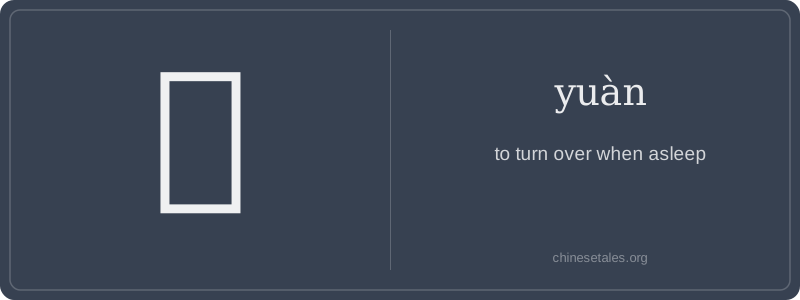
The earliest form of 夗 appears in oracle bone inscriptions as a minimalist, elegant silhouette: a bent human figure lying on its side, limbs subtly curved, head tilted — unmistakably a sleeper mid-turn. The top stroke was the head and shoulder curve; the two downward strokes represented arms and legs folded inward; the final dot or short stroke? A tiny foot lifting, mid-rotation. Over centuries, as script evolved from oracle bone to bronze to seal script, the figure simplified: the body became the 夕 radical (originally depicting the moon/sunset — evoking night and rest), while the lower strokes condensed into the distinctive 'three-dot-and-hook' shape () that now forms the bottom — still echoing that lifted foot and twisting torso.
This visual logic held steady: 夗 wasn’t about waking movement, but the unconscious choreography of sleep. In classical texts like the *Shuōwén Jiězì* (121 CE), it’s defined as 'body turning in repose' — emphasizing stillness-as-context. Later, in Song dynasty medical manuscripts, it appeared in descriptions of healthy sleep patterns, where 'freely 夗-ing' signaled relaxed qi flow. Even today, its rarity makes it precious: a linguistic fossil preserving an ancient, bodily truth — that how we move in sleep reveals something essential about our inner calm.
Think of 夗 (yuàn) as Chinese’s answer to the universal, slightly embarrassing bedtime drama: rolling over in your sleep and accidentally kicking the blanket off — or your partner. Its core meaning isn’t just ‘to turn’ but specifically the involuntary, dreamy, half-conscious twist of the body while asleep — a micro-gesture so intimate and unguarded that it rarely appears in formal writing, yet pulses with quiet humanity. It’s not used alone as a verb in modern speech; instead, it lives almost exclusively in compound verbs like 翻夗 (fān yuàn) or as part of poetic or descriptive phrases.
Grammatically, 夗 is a bound morpheme — it won’t stand solo like 走 (zǒu, 'to walk') or 吃 (chī, 'to eat'). You’ll never hear someone say 'I yuàn' — it always partners up: usually with 翻 (fān, 'to flip/turn over'), forming 翻夗, or occasionally with 滚 (gǔn, 'to roll'). Its tone (yùan, fourth tone) rhymes with ‘won’ — a helpful anchor, since the action feels like a quiet, decisive ‘win’ against gravity… until you’re tangled in sheets again.
Culturally, 夗 carries gentle, almost literary warmth — it’s the kind of word you’d find in Tang dynasty poetry describing a child’s restless slumber, or in a modern short story evoking vulnerability. Learners often misread it as 夕 (xī, 'evening') due to the shared radical, then stumble into absurd translations like 'evening turning' — a reminder that radicals hint at themes (here, twilight → rest → sleep), not direct meanings. Also, don’t confuse it with the more common 翻 (fān); 夗 adds the nuance of *unintentional*, *sleep-related* motion — a subtle but vital distinction.