夂
Character Story & Explanation
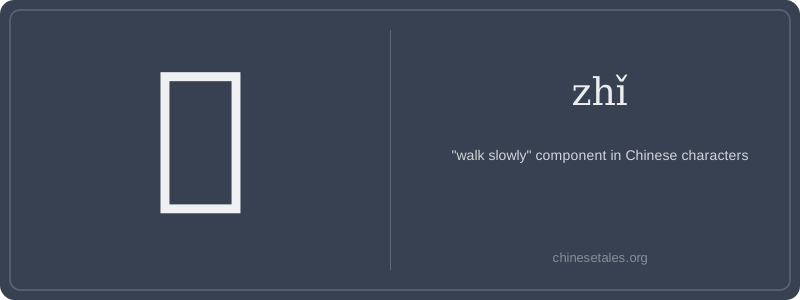
Carved into ox scapulae over 3,200 years ago, the earliest form of 夂 looked like a stylized human figure walking — legs bent mid-stride, arms swinging, head slightly bowed. In bronze script, it became more angular: three clear strokes — a descending curve (representing the forward-leaning torso), a leftward hook (a bent knee stepping back), and a final firm vertical (the planted foot). Over centuries, the figure simplified, losing facial details and limb articulation, until Shuōwén Jiězì (121 CE) formalized it as the minimalist three-stroke radical we know today — still unmistakably evoking measured gait, not haste.
This ‘slow walk’ wasn’t about laziness — it was sacred tempo. In the Book of Songs (Shījīng), characters containing 夂 appear in verses describing royal processions and seasonal sacrifices, where pace signaled reverence and cosmic alignment. The Confucian ideal of ‘walking the Way’ (dào) subtly echoes this: virtue isn’t rushed, but embodied step-by-step. Even today, when you see 夂 embedded in 夏 (summer), you’re glimpsing an ancient agrarian society marking the year not by clocks, but by the slow, inevitable rhythm of sun and soil — all encoded in three strokes.
Don’t be fooled by its tiny size — 夂 (zhǐ) is a stealthy semantic engine, not a standalone word. It’s one of Chinese’s oldest ‘walking’ components, representing slow, deliberate movement: think strolling through a temple garden, not sprinting for the bus. Unlike common radicals like 走 or 辶, 夂 doesn’t appear alone in modern speech; it lives exclusively as a quiet meaning-carrier inside characters like 夏 (xià, summer — originally depicting a person with arms and legs extended in ritual dance), 备 (bèi, to prepare — hands + 夂 = moving carefully to get ready), and 各 (gè, each — ‘to arrive’ + 夂, implying individual arrival). Its ‘slow walk’ nuance is subtle but persistent: it signals intentionality, completion of motion, or ceremonial pacing.
Grammatically, you’ll never conjugate 夂 or use it in isolation — it has no independent grammatical function. Instead, it shapes the core meaning of compound characters. For example, in 夏, the 夂 suggests rhythmic, grounded movement tied to seasonal cycles; in 备, it implies methodical preparation over time. Learners sometimes misread it as a variant of 夕 (xī, evening) or 攵 (pū, ‘tap’ radical), leading to wrong character breakdowns — but 夂 has no connection to time or striking. Its strokes are distinct: a gentle downward curve, then a soft hook left, then a decisive downward stroke — like footsteps slowing to a stop.
Culturally, 夂 embodies early Chinese cosmology: movement isn’t just physical — it’s ritual, seasonal, and harmonious. In oracle bone inscriptions, it often appears in contexts related to harvest rites or ancestral processions. Modern learners rarely encounter it directly, but recognizing it unlocks dozens of high-frequency characters. A common mistake? Assuming it’s decorative — nope! It’s semantic DNA. If you see 夂, ask: ‘What kind of intentional, unhurried action does this character describe?’ That question alone will deepen your reading intuition.