壸
Character Story & Explanation
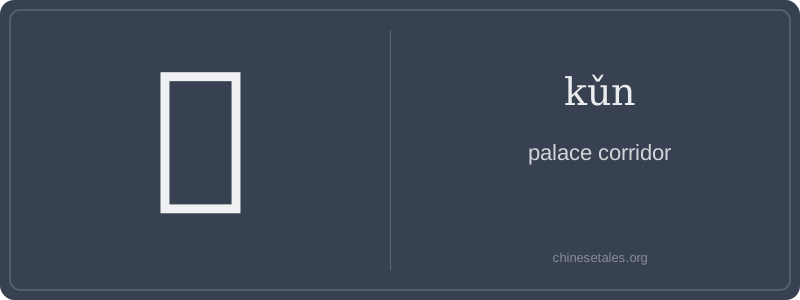
The earliest form of 壸 appears in bronze inscriptions of the Western Zhou dynasty (c. 1046–771 BCE) as a stylized pictograph: two parallel horizontal lines (representing roof beams) enclosing a simplified floor plan — two vertical strokes with a central crossbar, suggesting a walled, enclosed passage. Over centuries, the top evolved into the radical 冖 (mì, 'cover'), while the lower part solidified into 亞 (yà, an ancient symbol for 'ordered layout' or 'ritual ground plan'), not 豆 as sometimes misread. By the Han dynasty, the structure was standardized: 冖 over 亞 — a visual metaphor for 'covered, symmetrical, bounded space'.
This wasn’t just any hallway — it was the ceremonial corridor linking ancestral temples to sacrificial altars, later repurposed in palace design to separate imperial authority (outer court) from domestic life (inner court). In the Book of Rites (Lǐjì), 壸 appears in passages regulating women’s movement: '婦人無故不踰壙' — though often misquoted, the original term was 壸, signaling ritual boundaries. Its shape — a cover over an ordered plan — became a linguistic seal for 'regulated interiority', making it one of the few characters whose very stroke order enacts its meaning: descent (冖) over structure (亞).
Think of 壸 (kǔn) as the 'cloister' of Chinese architecture — not a building itself, but the quiet, covered passageway connecting imperial halls, where eunuchs whispered secrets and palace ladies walked with downcast eyes. It’s not about grandeur, but transition, privacy, and controlled movement: a semantic corridor between power and seclusion. Unlike common nouns like 殿 (diàn, 'hall') or 宫 (gōng, 'palace'), 壸 is almost exclusively literary and classical — you’ll never hear it in modern speech or see it on subway signs.
Grammatically, 壸 functions only as a noun, typically in compound terms or poetic phrases; it doesn’t take aspect particles (了, 过), modifiers like 很, or plural markers. You won’t say *‘kǔn le’* or *‘hěn kǔn’*. Instead, it appears in fixed expressions like 壸奥 (kǔn ào, 'inner sanctum') or as part of historical titles — think of it like English ‘vestibule’ or ‘ambulatory’: precise, architectural, and deliberately archaic. Its tone (third tone) and rarity make pronunciation tricky — learners often misread it as kùn (like 困) or kūn (like 昆).
Culturally, 壸 carries gendered resonance: in classical texts, it subtly evokes the inner quarters — the women’s domain — echoing Confucian spatial hierarchy (外为阳,内为阴). Modern learners rarely encounter it outside Tang poetry or Song dynasty inscriptions, so mistaking it for more common characters (like 壶 or 壹) is the #1 pitfall. Its near-total absence from spoken Mandarin makes it a 'ghost character' — visible in ink, silent in life.