壴
Character Story & Explanation
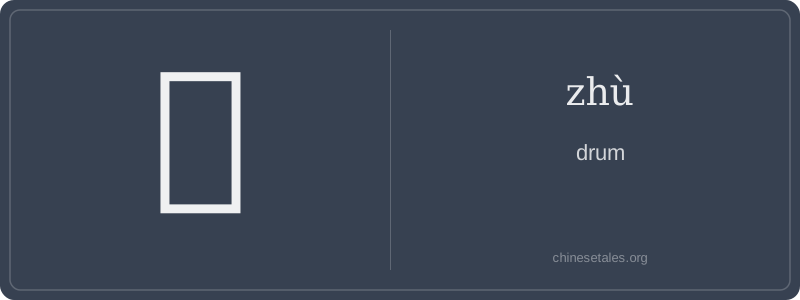
The earliest form of 壴 appears in Shang dynasty oracle bone inscriptions as a striking pictograph: a vertical pole flanked by two taut, curved drumheads — sometimes with visible lacing or hanging cords. Imagine a tall wooden frame with stretched animal hide on both sides, drawn with bold, economical lines. Over centuries, the side drumheads simplified into horizontal strokes (一), the central pole became the vertical line (丨), and decorative elements — like the ornamental finial atop the pole and stabilizing feet at the base — hardened into the top dot (丶) and bottom ‘crossbar + dot’ (士-like base). By the small seal script era, the shape had crystallized into today’s nine-stroke form: 丶 (top dot), 一 (upper drumhead), 丨 (pole), 一 (lower drumhead), and the radical base 士 representing the drum’s grounded, dignified stance.
This character didn’t just depict an object — it encoded cosmology. In the *Rites of Zhou*, 壴 was specified for ‘yin’ (receptive, earthly) rituals, paired with the yang ‘bell’ (鐘). Its placement in temple architecture followed strict feng shui logic: facing south, aligned with the sun’s path. Confucius praised its use in music education — not for entertainment, but to cultivate *jìng* (reverent stillness) before sound. Even today, calligraphers treat 壴 as a masterclass in balance: the upper and lower 一 must echo each other in length and weight, the central 丨 must pierce them without wobble, and the final 士 must anchor the whole like a scholar’s calm resolve — because in ancient China, drumming wasn’t noise; it was disciplined resonance made visible.
At first glance, 壴 (zhù) looks like a quiet, almost forgotten relic — and that’s exactly the point. It’s not a word you’ll hear in daily conversation; it’s the ancient, ceremonial 'drum' — not the modern jīgǔ or gǔ, but the sacred, ritual drum of Shang and Zhou dynasty ancestral rites. In classical Chinese, 壴 evokes solemnity, resonance, and cosmic order: drums marked time for sacrifices, summoned spirits, and synchronized human action with heaven’s rhythm. Its feel is weighty, dignified, and deeply visual — less 'instrument' and more 'symbol of authoritative presence.'
Grammatically, 壴 appears almost exclusively as a component in compound characters (like 鼓, 龍, or 声), rarely standing alone in modern texts. You won’t say *‘wǒ yǒu yī gè zhù’* — that would sound archaic or poetic, like saying ‘I own a lyre’ in English when you mean ‘guitar’. Instead, it functions like a fossilized root: silent in speech but roaring in meaning. When it does appear independently (e.g., in bronze inscriptions or calligraphy titles), it’s always capitalized by context — think of it as the ‘Roman numeral III’ of drums: elegant, precise, and reserved for ceremony.
Learners often misread 壴 as 士 (shì, ‘scholar’) or 持 (chí, ‘to hold’) due to shared strokes — but here’s the cultural trap: confusing 壴 with those characters erases millennia of sonic ritual. This isn’t just ‘a drum’ — it’s the drum that opened the Zhou court’s morning assembly. Modern mistakes usually involve over-assigning phonetic value (it’s not related to zhù as in zhùmíng) or misplacing it in compounds (e.g., writing 壴+攵 instead of 鼓). Remember: 壴 doesn’t drum — it *is* the drum’s soul, carved in bronze and silence.