壬
Character Story & Explanation
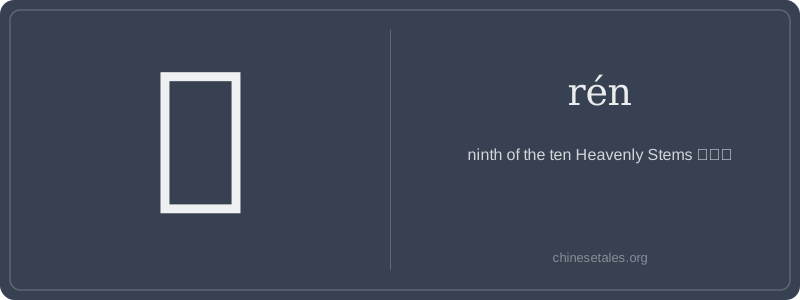
Carved into oracle bones over 3,000 years ago, 壬 began as a simple, bold vertical line — 丨 — representing a pole, pillar, or cosmic axis. Scribes added two short horizontal strokes near top and bottom (like tiny arms reaching out), turning it into the ancient form that looked like a person standing tall with arms akimbo — symbolizing centrality, authority, and upright alignment with Heaven and Earth. Over centuries, those horizontals shrank and straightened; the central line thickened slightly; and by the Han dynasty seal script, it had crystallized into the clean, balanced four-stroke shape we write today: a strong vertical flanked symmetrically by two short horizontals — no curves, no flourishes, just serene structural integrity.
This visual stability directly mirrors its philosophical role: in early cosmology, 壬 was linked to the ‘central direction’ and Yang Water — not water as liquid, but as the dynamic, life-sustaining principle of flow and potential. The Shuō Wén Jiě Zì (121 CE) defines it as ‘governing all things’, reflecting how the ninth stem anchors the cycle before renewal. In classical texts like the I Ching, 壬 appears in hexagram commentaries tied to timing and ripeness — not as a standalone concept, but as the invisible hand guiding when action should rise, recede, or transform.
Think of 壬 (rén) not as a word you’ll use in daily chat, but as a quiet VIP in China’s cosmic operating system — the ninth of the Ten Heavenly Stems (十天干), which team up with the Twelve Earthly Branches to form the 60-year cyclical calendar used for centuries in astrology, historiography, and even traditional medicine. Its ‘meaning’ isn’t lexical like ‘apple’ or ‘run’ — it’s ordinal, symbolic, and deeply calendrical: it carries the weight of position (9th), elemental association (Yang Water), and seasonal resonance (late autumn/early winter). You won’t say ‘壬 is cold’ — but you *will* see it stamped on antique almanacs, temple inscriptions, or your Chinese friend’s Bazi (八字) birth chart.
Grammatically, 壬 never stands alone as a noun or verb — it’s always part of a compound or label. It appears in terms like 壬辰年 (rén chén nián, the ‘Rén-Chen Year’) or paired with numbers in formal dating (e.g., 壬寅年 = 2022). Learners sometimes try to pronounce it as ‘rēn’ (first tone) — but it’s firmly second tone: rén — like ‘run’ with a rising lilt. And crucially: it’s *never* used for ‘nine’ (that’s 九 jiǔ); confusing the two is like mixing up ‘IX’ and ‘9’ in Roman numerals — same position, totally different systems.
Culturally, 壬 embodies Water’s paradox: soft yet unstoppable, yielding yet structuring — much like the stem itself, which governs flow, adaptability, and hidden depth. Mistake it for a number? You’ll misread dynastic records. Skip its tonal nuance? Your fortune-teller might raise an eyebrow. Its power lies in precision: one stroke off, and you’re not just misspelling — you’re misaligning with celestial time.