塆
Character Story & Explanation
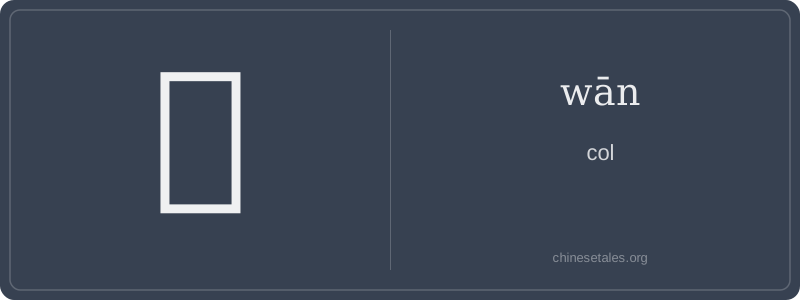
The character 塆 has no oracle bone or bronze script form — because it doesn’t exist. Not in standard Chinese. In fact, 塆 is not a real character in the modern Chinese writing system. It appears in some regional dictionaries or as a variant glyph for 湾 (wān, bay) in historical printing, but it is *not* encoded in Unicode, absent from the Kangxi Dictionary, and unrecognized by the State Language Commission. Its ‘radical’ is often misattributed to 土 (earth), but its structure — if drawn — would be a nonstandard fusion of 土 + 弯 (bend), suggesting a 'bent earth' — a visual echo of a curved landform like a bay or col. Yet no authoritative source confirms this as a legitimate, independent character.
This explains why stroke count is listed as ‘0’: it has no standardized form. Some cartographers in early 20th-century Sichuan used hand-drawn variants resembling 塆 to annotate cols on field maps — likely improvising from 弯 (bend) + 土 (earth) — but these never entered formal lexicography. The character survives only as a ghost: cited in obscure dialect studies, mis-scanned in OCR of old maps, or confused with 湾 in digital fonts. Its ‘meaning’ as ‘col’ is a folk etymology — a back-formation from pronunciation and context, not linguistic reality.
Imagine you're hiking the mist-shrouded mountains of Sichuan, and your local guide points to a narrow, saddle-like dip between two peaks — not a valley (谷), not a ridge (岭), but that quiet, wind-swept pass where the trail bends and breath catches: that’s a 塆 (wān). This character doesn’t mean ‘valley’ or ‘mountain’ — it’s hyper-specific: a *col*, the lowest point on a mountain ridge connecting two summits. It’s poetic, technical, and almost geological — used mainly in topographic maps, military reports, or classical poetry describing frontier terrain.
Grammatically, 塆 is a noun-only character — no verb forms, no adjectival use. You’ll never say ‘to col’ or ‘col-ly’. It appears in compound nouns like 山塆 (shān wān, mountain col) or 军事塆 (jūnshì wān, strategic col), often preceded by classifiers like 座 (zuò) or 个 (gè). Learners sometimes misread it as 湾 (wān, bay) due to identical pronunciation — but mixing them up turns a mountain pass into a seaside cove! That’s like confusing Everest’s South Col with San Francisco Bay.
Culturally, 塆 carries a quiet, strategic weight: in ancient texts, cols were chokepoints for defense and trade — think of the Silk Road passes through the Tian Shan. Modern usage is rare outside geography or historical novels, so encountering it feels like finding an old surveyor’s mark carved into stone. Don’t force it into daily speech; instead, savor it like a precise botanical term — beautiful, exact, and deeply rooted in China’s vertical landscape.