坜
Character Story & Explanation
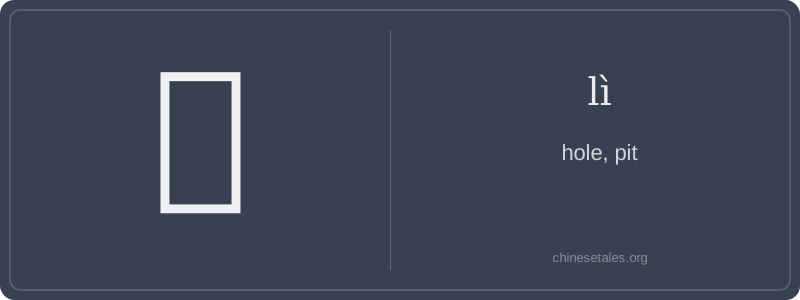
The earliest form of 坜 appears in late Shang oracle bone inscriptions as a simple pictograph: a square or rectangular shape (representing the mouth of the pit) with a dot or short line inside — symbolizing depth or contents. By the Zhou bronze script era, the 'earth' radical 土 was added on the left to clarify semantic domain, while the right side evolved from a stylized pit outline into the current '历' component — originally a phonetic hint (lì), though its modern meaning ('calendar', 'experience') is unrelated. The seven strokes solidified during the Qin small seal script: 土 (3 strokes) + 历 (4 strokes) = deliberate, grounded, and precisely measured.
This character’s meaning stayed remarkably stable across millennia — always 'man-dug earthen pit'. In the Book of Rites (Lǐjì), it appears in descriptions of ancestral tomb preparation: 'zuò lì wéi zàng' (dig pit for burial). Even in Ming dynasty vernacular fiction, 坜 retains its visceral, tactile weight — never abstracted into metaphor like 洞 or 穴. Its visual logic is flawless: the left side literally grounds the concept in soil; the right side, though phonetic, visually echoes layers of earth strata — a subtle stroke-level echo of depth itself.
Think of 坜 (lì) not as a generic 'hole', but as a *ground-level cavity* — a pit dug into the earth, often with purpose: for trapping animals, storing grain, or even burying things. Its radical 土 (tǔ, 'earth/soil') anchors it firmly in the physical world — this isn’t an abstract void like 空 (kōng), nor a natural cave like 洞 (dòng). It’s human-made, intentional, and slightly ominous — like the pit in the fable where the tiger falls in. You’ll rarely see it alone; it almost always appears in compound words, never as a standalone verb or noun in modern speech.
Grammatically, 坜 is strictly a noun and only appears in set phrases or technical/archaic contexts — never in daily conversation or HSK vocabulary. You won’t say 'I dug a lì'; you’d say ‘dig a kēng (坑)’ instead. But in classical texts or regional dialects (e.g., Shanxi folk narratives), 坜 pops up vividly: 'lì bù yǎn shì' (pit does not hide truth) — a metaphor for how hidden things inevitably surface. Learners sometimes misread it as lǐ (like 里) due to tone confusion, or overextend it to mean 'hole' in any context — a mistake that makes sentences sound archaic or literary, not colloquial.
Culturally, 坜 carries faint echoes of ancient land management and ritual — pits were used for boundary markers, sacrificial offerings, or even early wells. Its near-absence from modern usage makes it a linguistic fossil: still legible, still meaningful, but preserved mostly in dictionaries and historical novels. If you encounter it, pause — you’re not just reading a character; you’re stepping into a Bronze Age excavation site.