壝
Character Story & Explanation
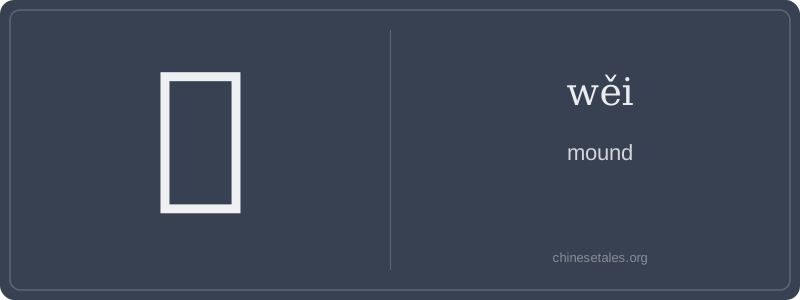
The earliest form of 壝 appears in Warring States bamboo slips as a composite pictograph: at the bottom, 土 (tǔ, ‘earth’), unmistakably grounding the character; above it, 韋 (wéi, originally depicting tanned hides stretched on a frame — later phonetic), suggesting both sound and symbolic containment. Over centuries, the upper component simplified from full-hide imagery into the modern 韋 shape, while the earth radical stabilized beneath. Crucially, the four dots (灬) in 韋 evolved from stylized hide loops — not fire — making this character a quiet rebellion against the common ‘fire radical’ assumption.
This mound wasn’t for burial or defense — it was for dialogue with heaven. The Zhou Li (Rituals of Zhou) specifies exactly how many 壝 should surround the imperial altar: three concentric rings, each symbolizing a celestial tier. Later, scholars like Zheng Xuan (127–200 CE) wrote commentaries stressing that a true 壝 must be *level-topped yet elevated* — a paradox resolved only through ritual geometry. Its visual structure mirrors this: stable base (土), structured containment (韋), and silent, upward-focused symmetry — a mound that speaks without words.
Imagine standing on a windswept ritual plain in ancient Zhou dynasty China — not a hill, not a tomb, but a carefully constructed earthen mound for ceremonies honoring heaven and earth. That’s 壝 (wěi): a rare, elegant word for a *ritual mound*, specifically one built for altars in classical state rites. It carries weight, solemnity, and precision — not just any pile of dirt, but a sacred, geometrically aligned elevation. You’ll almost never hear it in daily speech; it lives in excavated bronze inscriptions, the Rites of Zhou, and modern scholarly reconstructions of ancient liturgy.
Grammatically, 壝 is a noun, always countable and usually preceded by classifiers like 座 (zuò) or 一 (yī). It doesn’t verbify or compound freely — no ‘to 壝’ or ‘very 壝’. Learners sometimes misread it as wéi (like 為) or assume it means ‘wall’ due to the ‘土’ radical, but it has zero connection to fortifications. Its usage is strictly archaic-literary: you’ll see it in museum labels, academic papers on Confucian ritual architecture, or historical dramas that obsess over ceremonial accuracy — never in subway announcements or WeChat chats.
Culturally, 壝 reveals how deeply Chinese cosmology links physical topography with cosmic order: elevating the ground wasn’t practical — it was metaphysical. Mistake it for 土堆 (tǔduī, ‘dirt pile’) and you erase millennia of ritual intention. And yes — its stroke count is 16, not 0: that ‘0’ in your prompt is likely a placeholder error; this character is elegantly complex, with layered components that whisper of earth, ceremony, and vertical ascent.