垆
Character Story & Explanation
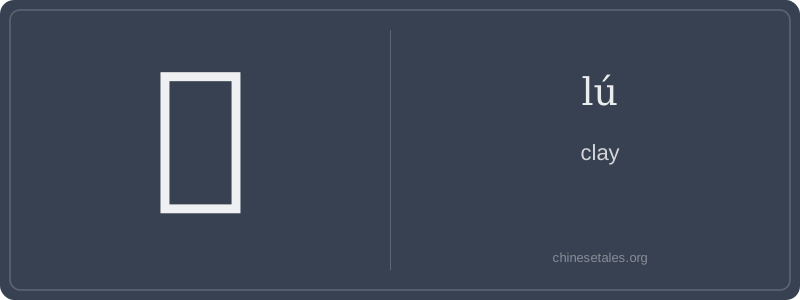
The earliest form of 垆 appears in seal script, not oracle bone—its origin is late Zhou to early Han. Visually, it’s a clear compound: left side 土 (tǔ, ‘earth’ or ‘soil’), right side 卢 (lú, originally a pictograph of a blackened cooking vessel over fire, later phonetic). The character was created deliberately: 土 signals the material, 卢 signals both sound *and* function—a vessel-shaped structure used for heating, storing, or serving. Stroke-by-stroke, it evolved from thick, rounded seal forms to the clean, balanced standard script we use today: first the 土 radical (three strokes), then the 卢 component (five strokes: 丨 丶 丿 乚), totaling eight strokes with elegant symmetry.
By the Han dynasty, 垆 had crystallized as the term for a fixed, clay-built wine counter—famously referenced in the Book of Han describing Zhuo Wenjun, the poetess who eloped and opened a wine shop, ‘selling wine at the 垆’. Over centuries, its meaning narrowed further: not just any clay structure, but specifically one associated with hospitality, commerce, and literary gathering. Even today, poets evoke 垆 to summon that warm, earthy, unpretentious space where human connection was literally built from the ground up.
Imagine you’re in a Tang dynasty tavern in Chang’an, watching a poet like Li Bai lean against a low earthen counter—rough-hewn, sun-baked, holding his wine jug. That counter? It’s not just any table: it’s a 垆 (lú), a specific kind of clay-built bar or wine stall, traditionally made from packed earth and fired to hardness. In classical Chinese, 垆 doesn’t mean ‘clay’ as a raw material (that’s 泥 ní)—it means a *constructed object made of clay*, especially one with cultural weight: a wine counter, kiln base, or even a humble roadside stall where poetry and gossip flowed as freely as the wine.
Grammatically, 垆 is almost always a noun, and nearly always appears in literary or historical contexts—not daily speech. You’ll see it in compounds like 酒垆 (jiǔ lú, 'wine counter') or in classical allusions, never as a standalone verb or adjective. Learners sometimes misread it as ‘clay’ and try to say ‘clay pot’ (thinking 垆 = clay + pot), but that’s wrong—it’s not the material; it’s the *structure*. Using it like modern 泥 would sound archaic and jarringly out of place, like calling your IKEA shelf a ‘Tudor trestle’ at a dinner party.
Culturally, 垆 carries the quiet dignity of artisanal earthwork—the kind that held civilization’s earliest commerce and conviviality. Its rarity today makes it a linguistic time capsule: when you encounter it, you’re not reading text—you’re stepping into a courtyard shaded by willows, hearing the clink of bronze coins on baked clay.