圹
Character Story & Explanation
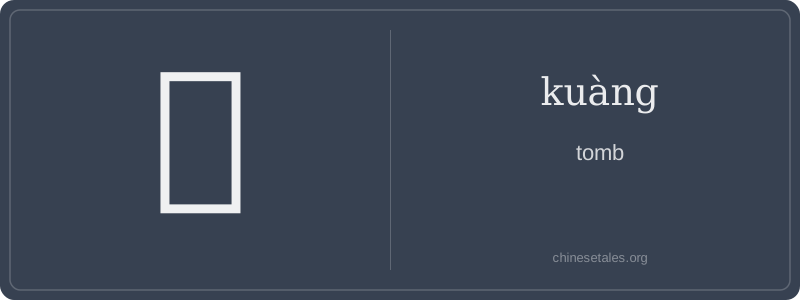
The earliest form of 圹 appears in bronze inscriptions of the Western Zhou dynasty (c. 1046–771 BCE) as a pictograph showing a rectangular pit dug into undulating earth — two horizontal lines representing soil layers, with a vertical stroke descending between them, and a small hook or dot marking the excavation point. Over centuries, the upper soil lines simplified into the two horizontal strokes of the modern top, the vertical became the central stroke, and the bottom ‘opening’ evolved into the final 丶 (dot) — all while retaining the radical 土 on the left to emphasize its earthly, dug-from-the-ground nature.
By the Warring States period, 圹 had crystallized as the technical term for a prepared burial pit — distinct from natural caves or shallow graves. It appears in the Zuo Zhuan describing Duke Ling of Qi’s lavish tomb: '鑿地為塹,深十仞,以藏其柩' ('They dug a trench ten ren deep to house his coffin') — where 'trench' echoes 圹’s core sense of intentional excavation. The character’s visual austerity — six clean strokes, no flourish — mirrors its function: functional, solemn, and unadorned, like the pit itself.
Think of 圹 (kuàng) as the Chinese equivalent of a 'crypt' — not just any grave, but a carefully dug, subterranean chamber for the dead, evoking the solemn precision of an ancient Egyptian burial shaft or a Gothic mausoleum. It’s far more specific and literary than the common word 墓 (mù, 'tomb') — 圹 carries weight, antiquity, and spatial intention: it’s *the pit*, the excavated earth itself, not just the site above it. You’ll almost never hear it in daily speech; it lives in classical texts, archaeological reports, or poetic lamentations.
Grammatically, 圹 is a noun, rarely used alone — it appears in compounds (like 義塚 or 廟塚) or in formal/ritual contexts. Learners sometimes misread it as 'mine' (kuàng also means 'ore/mine'), but that’s a homophone with a different character (礦). Crucially, 圹 is never used for modern cemeteries or casual references to death — dropping it into 'I visited my grandfather’s tomb' would sound like quoting a Han dynasty edict. Instead, it appears in set phrases like '掘塚' (jué kuàng, 'to dig up a tomb') — a phrase steeped in taboo and historical scandal.
Culturally, 圹 reflects the deep Confucian reverence for proper burial: the earth must be *dug* with ritual care — hence the 土 (earth) radical anchoring the character. Mistaking it for 塚 (zhǒng, also 'mound/tomb') is common, but 塚 implies a raised earthen mound *above* ground, while 圹 is definitively *below*. Its rarity in spoken Mandarin makes it a telltale marker of literary fluency — like using 'sepulcher' instead of 'grave' in English.