壔
Character Story & Explanation
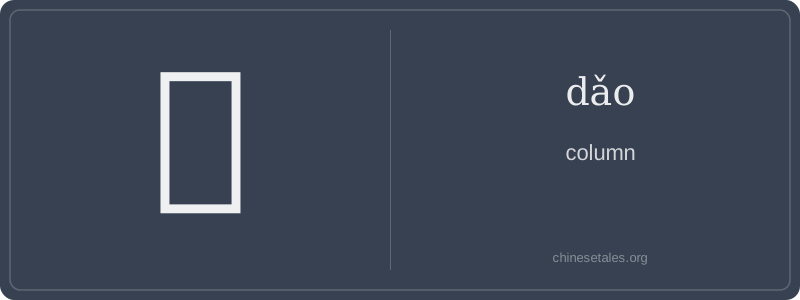
The earliest form of 壔 appears in bronze inscriptions from the late Zhou dynasty (c. 5th century BCE) as a highly stylized pictograph: two parallel vertical lines representing upright stones or timbers, flanked by two short horizontal strokes suggesting base and capital—and crucially, a centered 'earth' radical (土) beneath them, anchoring the whole structure literally and cosmologically. Over centuries, the side strokes condensed into the left-hand component (壴, an ancient variant of 'drum stand' implying vertical support), while the earth radical sank to the bottom, solidifying into today’s 壔—still visually shouting 'grounded verticality.'
This character was never about decorative columns—it was about *load-bearing legitimacy*. In the Classic of Poetry, 壔 appears in odes praising royal palaces where 'the four 壔 stand unshaken'—referring not to ornamentation but to foundational pillars ensuring dynastic stability. Later, Daoist geographers used it to name sacred peaks believed to physically prop up the sky (e.g., the 'Four Great 壔 Mountains'). Its shape—rigid, symmetrical, rooted—mirrors its meaning: unwavering vertical authority anchored in the earth.
Think of 壔 (dǎo) not as a 'column' like a Greek marble pillar, but as a *structural anchor*—like the central support beam in a timber-frame barn: invisible in daily use, yet absolutely critical for holding everything upright. In classical Chinese, it rarely stands alone; instead, it appears embedded in compound words describing vertical supports in architecture, geography, or even metaphorical structures—such as a 'pillar of virtue' or 'main column of a mountain range.' You’ll almost never see it as a standalone noun in modern speech (unlike 柱 zhù, the common word for 'column'), and trying to say 'this is a 壔' will sound archaic or poetic, like saying 'lo! a pilaster!' at a coffee shop.
Grammatically, 壔 functions exclusively as a noun within compounds—it doesn’t take aspect particles (了, 过), isn’t modified by adjectives directly (you wouldn’t say *big 壔*), and never serves as a verb or measure word. Its presence signals formality, antiquity, or technical precision—think architectural blueprints or Tang dynasty poetry describing palace foundations. Learners often misread it as 捣 (dǎo, 'to pound') due to identical pinyin and similar stroke density—but that’s like confusing 'architrave' with 'avocado' just because they both start with 'a' and have three syllables.
Culturally, 壔 evokes the ancient Chinese worldview where physical structure mirrors cosmic order: columns weren’t just supports—they aligned heaven and earth. That’s why you’ll find it in texts describing ritual altars or mountain ranges deemed 'pillars of the realm.' A common mistake? Using it where 柱 or 根 would be natural—e.g., saying *yī gēn dǎo* for 'one column' (wrong: should be *yī gēn zhù*). Remember: 壔 belongs in inscriptions, not invoices.