壒
Character Story & Explanation
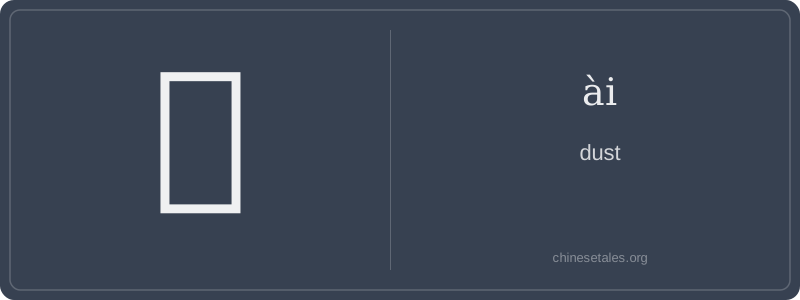
The earliest form of 壒 appears in bronze inscriptions as a stylized pictograph: a horizontal line (一) representing the ground, beneath which two stacked, wavy, downward-curving strokes (like inverted ‘S’ shapes) depicted fine particles sinking slowly — not blowing, but *settling*. Over centuries, those wavy strokes hardened into the two ‘dust dots’ (丶丶) atop the ‘earth’ radical (土), while the base evolved from a simple line into the full 土 radical we know today. The modern character retains this vertical hierarchy: dust above earth — a visual metaphor for deposition, not dispersion.
This meaning crystallized in early ritual texts like the Rites of Zhou, where 壒 described the thin layer of ash-and-dust left after ancestral incense burned out — a sign of completed devotion and quiet continuity. By the Han dynasty, it appeared in Ban Gu’s Book of Han describing neglected imperial shrines: '壝垣壒积,鸟雀巢其上' ('The ritual walls were covered in 壒, birds nested atop them'). Its visual stillness — no wind strokes, no motion radicals — mirrors its semantic stillness: dust that has *finished falling*.
Here’s the truth no textbook will tell you: 壒 (ài) doesn’t mean ‘dust’ — not in the way we think of dusty bookshelves or desert winds. It means *settled dust*, the fine, silent layer that accumulates over time on still surfaces: altars, ancestral tablets, abandoned scrolls. Its core feeling is quiet accumulation, temporal weight, and sacred neglect — not airborne particles. You’ll almost never hear it in spoken Mandarin; it lives in classical poetry, ritual texts, and literary descriptions of decay or reverence.
Grammatically, 壒 is a noun that rarely stands alone. It appears in compounds like 壒土 (ài tǔ, 'ritual dust-soil') or as a poetic modifier — e.g., 壒积 (ài jī, 'dust-accumulated', meaning 'long-neglected'). Unlike common words for dust (尘 chén or 土 tǔ), 壒 carries no verb forms, no adjectival usage, and zero colloquial frequency. Learners who try to substitute it for 尘 in 'dust storm' (沙尘暴 shā chén bào) will sound like someone quoting a Tang dynasty priest at a construction site.
Culturally, 壒 evokes ancestral veneration and impermanence — the dust that settles where time pauses. Mistake it for 愛 (love) or 隘 (narrow pass), and you’ve swapped reverence for romance or geography. Its rarity means even native speakers pause before writing it — often double-checking the radical. That silence? That’s the dust settling.