壎
Character Story & Explanation
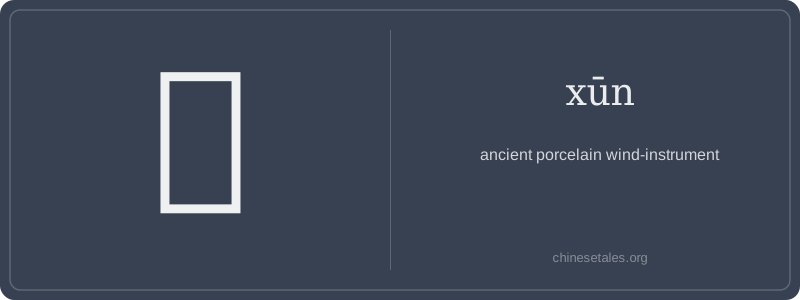
The earliest form of 壎 appears on late Shang oracle bones as a simple, rounded pictograph with three short vertical lines inside—representing finger holes—and a subtle curved line suggesting the instrument’s mouthpiece. By the Western Zhou bronze inscriptions, it evolved into a more structured form: a box-like enclosure (later becoming the ‘士’ top) cradling a central cavity (the ‘冖’ cover), with strokes beneath hinting at the base and breath channel. The modern character crystallized in seal script: the upper ‘士’ evokes dignity and ritual status, the middle ‘冖’ (a covering radical) symbolizes the enclosed air chamber, and the lower ‘員’ (yuán, originally ‘mouth + round’) conveys both circular shape and resonant opening—though phonetically, ‘員’ here serves as a sound clue, not semantic content.
Over centuries, 壎 shifted from functional object to cultural emblem. Confucius praised its ‘sound of sorrow and reverence’ in the Book of Rites, linking its muffled tone to moral restraint. During the Song dynasty, scholars revived it as part of ‘ritual music reconstruction’ movements—treating it less as an instrument and more as a philosophical artifact. Intriguingly, its visual structure reinforces this: the covered cavity (冖) literally suppresses volume, mirroring the Confucian ideal of measured expression. Even today, when a musician blows into a 壎, they don’t project—they invite inward listening. That quiet authority is baked into every stroke.
Imagine holding a small, egg-shaped clay flute with six finger holes—cool to the touch, slightly rough from hand-coiling, humming with the breath of Shang dynasty priests. That’s the 壎 (xūn): not just an instrument, but a vessel of ritual resonance. Its meaning is tightly bound to antiquity and solemnity; you’ll almost never see it in modern speech—it lives in museum labels, academic papers on Zhou rites, or poetic allusions to ‘the sound of vanished eras.’ Grammatically, it’s a noun-only character: no verbs, no adjectives, no compounding as a verb stem. You won’t say ‘to xūn’—there’s no such verb. It appears only as the head noun in phrases like ‘a xūn’ or ‘the xūn of the Western Zhou,’ always preceded by measure words (e.g., 一隻壎) or descriptive modifiers (ancient, black-glazed, ocarina-shaped).
Learners sometimes misread it as a variant of 熏 (xūn, ‘to smoke’), especially since both share the same pinyin and appear in classical texts—but that’s a dangerous homophone trap. While 熏 involves heat and fumes, 壎 involves breath and silence made audible. Also, beware of overgeneralizing its usage: it’s never used metaphorically (unlike 笛 or 箫), nor does it appear in idioms. If you write 壎 in an essay about modern music, your reader will assume you’re either quoting archaeology or making a very deliberate anachronistic joke.
Culturally, the 壎 carries profound yin symbolism—its low, muffled, earthy tone was believed to harmonize with the north, winter, and water in the Five Phases system. In the Rites of Zhou, it’s classified among the ‘earth instruments’ (土類樂器), played only during ancestral ceremonies to evoke humility and introspection. Today, fewer than two dozen master artisans still handcraft authentic 壎—and each one is tuned to match the pitch of ancient bronze bells unearthed from royal tombs. That’s how specific—and sacred—this little clay whistle remains.