垱
Character Story & Explanation
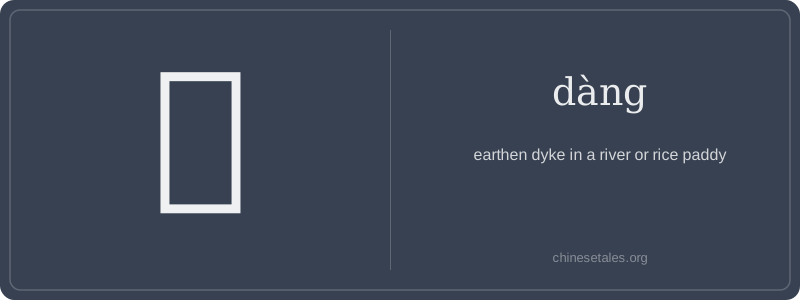
The earliest form of 垱 appears in Song-era leishu (encyclopedias) and Ming local gazetteers — not oracle bones or bronzes, since it was a late-appearing regional term. Its structure is transparent: left radical 土 (tǔ, ‘earth’), right component 当 (dāng, phonetic loan, indicating pronunciation). But here’s the twist: 当 was chosen not just for sound, but because its ancient form (+田+彐) evoked a bounded field — perfectly matching the function of a paddy dyke that ‘holds’ or ‘contains’ water within a defined plot. Over time, the right side simplified from the full 当 to its modern cursive-influenced shape, while the earth radical remained solid and grounded — literally anchoring the meaning.
This character didn’t appear in the Shuōwén Jiězì (121 CE), confirming its grassroots origin. It first surfaced in agricultural manuals of the Southern Song, describing how ‘田垱’ (tián dàng) separated flooded plots to regulate water depth for seedlings. By the Qing, it appeared in county maps labeled ‘河垱’ (hé dàng) — marking where villagers had raised soil against seasonal overflow. Its visual logic is elegant: earth + containment = controlled earth. No abstraction, no metaphor — just dirt, water, and human patience.
Think of 垱 (dàng) as China’s answer to the Dutch dike — not a grand engineered barrier like the Afsluitdijk, but a humble, hand-scooped earthen ridge in a rice paddy or along a slow-moving stream. It’s not a wall, not a dam, not even a levee in the Western engineering sense: it’s a low, grassy, sometimes crumbling berm built by farmers to gently hold or redirect shallow water — functional, organic, and quietly essential to wet-rice agriculture. You’ll almost never see it in modern Mandarin textbooks because it’s highly regional (predominantly Jiangsu, Zhejiang, and Anhui dialects) and nearly extinct in speech — surviving mostly in place names and local agrarian writing.
Grammatically, 垱 is almost always a noun, and it rarely stands alone. You’ll find it embedded in compound nouns (like 河垱 or 田垱) or as part of village names (e.g., ‘Liujiadang’). It never takes aspect markers (了, 过), doesn’t combine with verbs like ‘build’ or ‘cross’, and crucially — it’s *not* used metaphorically. Unlike 堤 (dī, ‘levee’) or 坝 (bà, ‘dam’), 垱 carries no political, military, or infrastructural weight; it’s stubbornly literal and local. Learners who encounter it in old texts or maps often misread it as 堤 or 坝 — a subtle but meaningful error that upgrades a farmer’s mud ridge into an imperial flood-control project!
Culturally, 垱 is a linguistic fossil — a whisper of pre-industrial hydrology. Its survival in toponyms (e.g., ‘Dangkou’ — ‘Dyke Mouth’) preserves centuries-old land-use patterns. Mistake it for 唐 (táng, ‘Tang dynasty’) or 当 (dāng, ‘to be’), and you’ll conjure dynasties or obligations instead of irrigation — a delightful, if muddy, mix-up.