墺
Character Story & Explanation
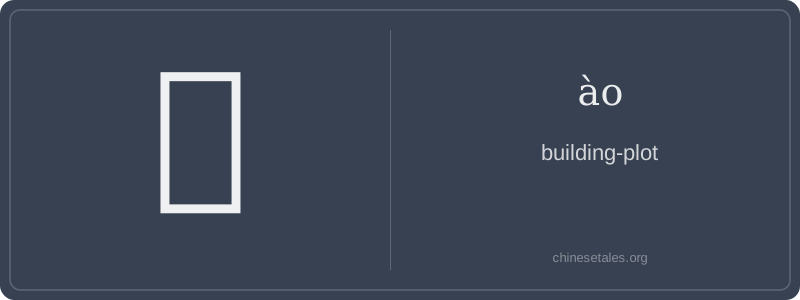
Look closely at 墺: it’s built from 土 (tǔ, ‘soil/earth’) on the left and 奧 (ào, ‘profound, deep’) on the right. But this wasn’t always so. Its earliest form — found in bronze inscriptions from the late Zhou dynasty — showed a stylized square plot bounded by low earthen berms, with a central marker (like a boundary stone). Over centuries, the pictograph simplified: the berms became the ‘square’ component inside 奧, while the earth element solidified as the explicit 土 radical. By the Han dynasty, the character had stabilized into its current two-part structure — no longer a drawing of dirt, but a conceptual fusion: *earth made meaningful through human designation*.
This evolution mirrors China’s ancient land management systems. In the Rites of Zhou (《周礼》), officials called ‘Situ’ (司徒) were tasked with measuring and assigning 墺 — not just any land, but plots allocated for ritual altars, granaries, or ancestral halls. The character thus absorbed connotations of legitimacy and purpose: unclaimed dirt becomes 墺 only when formally recognized. Even today, in legal texts, 墺 implies *jurisdictional readiness* — it’s the moment soil crosses into bureaucracy. Its visual weight — that dense, complex 奧 on the right — isn’t decoration; it’s the ‘deep procedure’ embedded in every surveyed square meter.
Let’s be honest: 墺 (ào) is a quiet character — not flashy, not in the HSK, but deeply architectural in its soul. It doesn’t mean ‘building’ or ‘house’; it means the *plot* — the cleared, level, prepared ground *before* construction begins. Think of it as the blank canvas of real estate: flat, surveyed, legally designated land ready for foundations. In Chinese, it carries a subtle sense of intentionality and bureaucratic readiness — you don’t ‘see’ an 墺; you ‘acquire’, ‘allocate’, or ‘develop’ one. It’s almost always paired with administrative verbs like 划定 (huàdìng, ‘to demarcate’) or 征用 (zhēngyòng, ‘to requisition’).
Grammatically, 墺 functions exclusively as a noun, nearly always in formal, technical, or legal contexts — never in casual speech. You’ll find it in land-use plans, municipal documents, or historical records about urban expansion. Learners often mistakenly treat it like 地 (dì, ‘ground/land’) and drop it into everyday phrases — but saying ‘我家的墺很大’ sounds like reading a zoning ordinance aloud at dinner. Instead, it appears in set phrases: 开发区墺 (kāifā qū ào, ‘development zone plot’) or 建设用地墺 (jiànshè yòng dì ào, ‘construction land plot’).
Culturally, 墺 reflects China’s deep-rooted emphasis on spatial order and planning — land isn’t just space; it’s *assigned potential*. A common mistake? Confusing it with 奥 (ào, ‘profound, mysterious’), which shares the same pronunciation but zero semantic overlap. Remember: 墺 has soil (the 土 radical!) — it’s literally *earth that’s been made ready*. If your sentence involves surveyors, blueprints, or government permits — welcome to 墺 territory.