墩
Character Story & Explanation
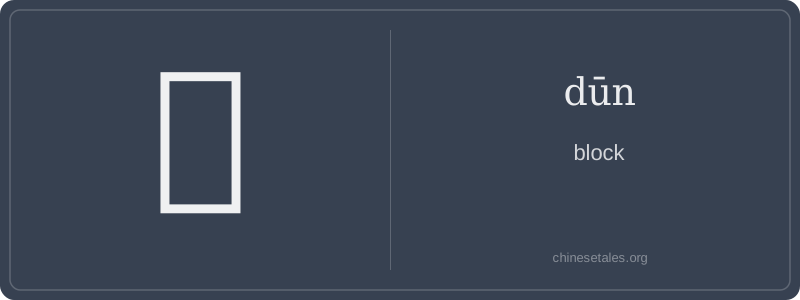
The earliest form of 墩 appears in Han dynasty seal script as a composite: the left side was clearly 土 (earth), while the right was 夆 (gōng), an ancient variant of 公 (gōng, 'public' or 'duke'), which itself derived from a pictograph of a hand holding a ruler — symbolizing authority and standard measure. Over centuries, 夆 simplified into 敦 (dūn), a character meaning 'honest', 'substantial', or 'weighty', reinforcing the idea of solidity. By the Song dynasty, the two components fused cleanly: 土 + 敦 = 墩 — a visual promise: 'earth made substantial'.
This evolution wasn’t accidental. In classical usage, 敦 appeared in texts like the Book of Rites (Lǐjì) to describe ceremonial vessels — heavy, bronze, foundational. When paired with 土, it naturally extended to earthen or masonry supports: the base upon which civilization rested. By Ming-Qing times, 墩 was standard in engineering manuals for bridge piers and city gate platforms — always low, wide, and unyielding. Its visual weight (15 strokes!) mirrors its semantic role: no frills, no flourish — just dependable mass.
At its heart, 墩 (dūn) is a grounded, weighty character — literally and figuratively. It evokes something solid, squat, and immovable: a stone block, a masonry pier, or even a thick pillar supporting a bridge. Unlike abstract nouns like 'block' in English, 墩 always implies physical mass, stability, and function — it’s never used for a cube of cheese or a digital 'block'. Think of it as the architectural cousin of 砖 (brick) or 柱 (pillar), but with more heft and less ornamentation.
Grammatically, 墩 is almost always a noun, rarely verbified. You’ll find it in technical, engineering, or construction contexts — not casual speech. Learners sometimes mistakenly use it where they mean 块 (kuài, generic 'piece') or 方块 (fāngkuài, 'square block'), but 墩 carries an implicit sense of load-bearing purpose. For example, you’d say 桥墩 (qiáo dūn, 'bridge pier'), not *桥块; saying ‘a dūn of tofu’ would sound hilariously over-engineered. It’s also occasionally used metaphorically — like 土墩 (tǔ dūn, 'earthen mound') — hinting at natural landforms shaped by time and pressure.
Culturally, 墩 appears in classical texts describing city walls, temple foundations, and imperial road infrastructure — always signifying structural integrity. A common learner trap? Confusing it with 遁 (dùn, 'to flee') due to similar pronunciation — but their meanings are polar opposites: one stands firm, the other runs away! Also, don’t forget the radical: 土 (earth/soil) anchors its meaning firmly in the material world — this isn’t abstract logic; it’s earth, stone, and gravity made visible.