墦
Character Story & Explanation
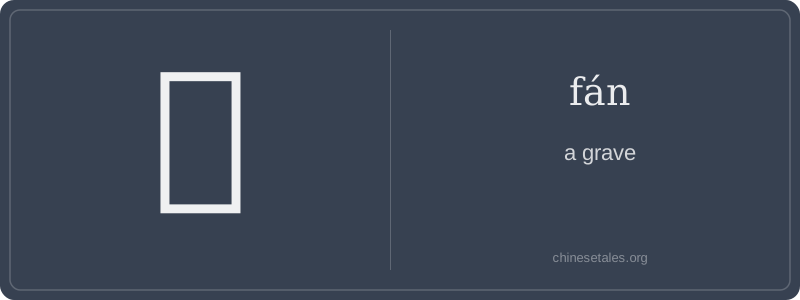
The earliest form of 墦 appears on late Shang oracle bones and Western Zhou bronzes as a striking pictograph: two parallel horizontal lines (representing the earth’s surface), with a central vertical line descending deep below them — not just a hole, but a *deliberately constructed earthen mound*, often flanked by simplified glyphs suggesting ritual markers or boundary stones. Over centuries, the upper lines thickened into the ‘two earths’ (two 土 radicals stacked), while the vertical became the central 番 component — originally depicting a turning plow or rotating ritual staff, signifying cyclical rites performed at the site. By the Han dynasty seal script, the structure solidified into today’s form: double 土 above, 番 below — literally 'earth upon earth, ritually tended.'
This visual evolution mirrors its semantic journey: from a concrete depiction of an earthen burial platform (in texts like the *Rites of Zhou*), to a metonym for the entire sacred tomb complex, and eventually to a poetic synonym for 'ancestral resting place' in Tang and Song poetry. Du Fu once wrote of ‘墦松’ (fán sōng) — pine trees growing atop ancient mounds — using 墦 not just for location, but as a synecdoche for time, memory, and the quiet dignity of the departed. The character doesn’t just name a place; it holds the shape of reverence itself.
Forget 'grave' as just a dictionary definition — 墦 (fán) is the quiet, solemn weight of ancestral memory carved into stone and soil. It’s not the generic word for tomb (that’s 墓 mù or 冢 zhǒng), but a literary, almost archaic term evoking ancient burial mounds, ceremonial earthen platforms, and the sacred geometry of ritual space. You’ll rarely hear it in daily speech — it lives in classical poetry, historical inscriptions, and formal epitaphs. Its feel is hushed, dignified, and deeply rooted in Zhou dynasty cosmology: this isn’t just where the dead rest — it’s where heaven, earth, and lineage converge.
Grammatically, 墦 functions almost exclusively as a noun, often paired with other characters to specify type or location: e.g., 封墦 (fēng fán) — a sealed, mound-covered grave; or 墦域 (fán yù) — the sacred precinct surrounding a tomb complex. It never appears alone in modern spoken Chinese — saying just ‘墦’ sounds like quoting a bronze inscription. Learners sometimes misread it as 販 (fàn, 'to sell') due to visual similarity, but that’s a catastrophic semantic leap from sacred earth to street commerce!
Culturally, 墦 reflects China’s profound topographic reverence: burial mounds were engineered landscapes — raised earth symbolizing ascent to ancestors, aligned with stars, layered with ritual meaning. Modern readers often overlook its radical (土 tǔ, 'earth') and assume it’s abstract — but no: every stroke points downward, grounding the character in soil, weight, and permanence. Mistake it for a mere synonym of 墓, and you’ll miss the quiet thunder of its historical resonance.