墝
Character Story & Explanation
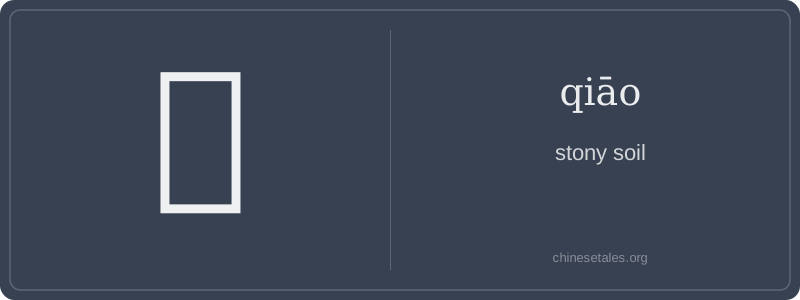
The earliest form of 墝 appears not in oracle bones, but in Han dynasty bronze inscriptions and bamboo slips — a rare case where the character was *invented* for technical precision rather than evolving from pictography. Its left radical 土 (tǔ, 'earth') anchors it firmly in geology, while the right side 隻 (zhī, archaic 'single; lone') was later simplified into 喬 (qiáo, 'tall; lofty'), though crucially *not* the same 喬 as in 喬木 (qiáomù, 'tall tree'). This visual fusion — 'earth + tall/lone' — originally conveyed 'soil so sparse and elevated it stands apart, bare and exposed', like rocky knolls jutting from loess plains.
By the Tang dynasty, 墝 had crystallized into its modern meaning in agronomic texts like the Simin Yue Ling (Monthly Ordinances for the Four Classes), where it distinguished marginal plots unfit for rice or wheat. The 'tallness' in 喬 subtly shifted: not physical height, but *structural elevation* — stones lifting the topsoil away from moisture-retaining sublayers. Poets like Du Fu used it metaphorically in frontier verses ('qiāo dì fēng shā è', 'stony soil, fierce wind, harsh sand'), embedding it in China’s literary geography of hardship. Visually, its 15 strokes map the labor of farming such land — each stroke a pickaxe strike against unyielding grit.
Think of 墝 (qiāo) as China’s linguistic equivalent of 'rocky soil' on a New England farm — not just stony, but stubbornly infertile, resistant to plowing, and quietly judgmental of your gardening ambitions. In Chinese, it doesn’t describe mere pebbles in dirt; it evokes land that *refuses* to yield — dry, shallow, gravel-laced earth where even drought-tolerant millet sighs and gives up. It’s an adjective with strong agrarian gravity: you’ll almost never see it standalone ('This soil is 墝') — instead, it appears in descriptive phrases like 墝地 (qiāo dì, 'stony ground') or compound nouns tied to land quality.
Grammatically, 墝 behaves like a classical root — rarely used as a verb or noun by itself, and virtually absent in spoken Mandarin today. You won’t hear it in casual chat or news broadcasts; it lives in agricultural surveys, soil science reports, and regional dialect literature (especially from Shaanxi and Gansu). Learners often misread it as a variant of 峭 (qiào, 'steep') or misapply it like 硬 (yìng, 'hard') — but while 硬 describes texture or attitude, 墝 is exclusively geological and ecological, carrying the quiet despair of farmers staring at cracked, stone-flecked fields after monsoon failure.
Culturally, 墝 carries unspoken class resonance: in traditional land registers, such soil was low-grade, taxed lightly because it yielded little — yet its very existence defined settlement patterns and migration routes. Modern learners stumble most by overgeneralizing: no, your laptop keyboard isn’t 'qiāo'; no, your stubborn uncle isn’t 'qiāo' — this word belongs only to earth, and only when that earth has *stones in its soul*.