墘
Character Story & Explanation
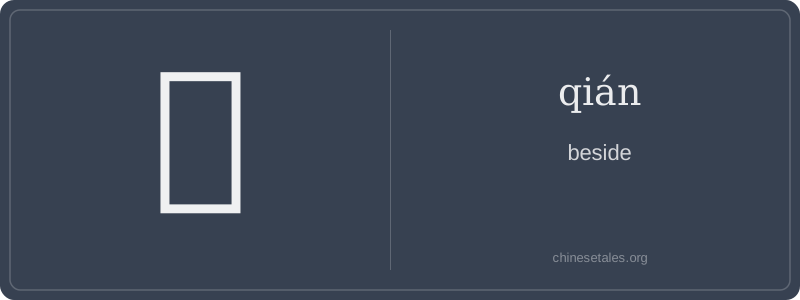
The earliest form of 墘 appears on Warring States bamboo slips as a radical-left structure: 土 (earth/ground) on the left, and a simplified depiction of two people standing side-by-side (亻+人, later stylized as 今) on the right. The original oracle bone script didn’t survive, but bronze inscriptions show it as 土 + 㐱 — where 㐱 represented ‘attendants standing in orderly rows beside a sovereign’. Over centuries, the right-hand component streamlined from 㐱 to 今 (phonetic clue for qián), while the left remained 土 — grounding the idea of ‘standing on the same earth, side by side’.
This visual logic held firm through the Han dynasty: in the *Shuōwén Jiězì*, Xu Shen defined it as ‘person standing beside another on level ground’ — emphasizing equality and shared footing. By the Tang, it appeared in imperial edicts describing courtiers ‘墘立丹墀’ (standing beside the red steps of the palace). Its meaning never shifted — only its usage narrowed, retreating from daily speech into ceremonial, poetic, and epigraphic domains, where precision and dignity matter more than frequency.
Let’s be honest: 墘 (qián) is a ghost character — elegant, ancient, and nearly extinct in modern spoken Chinese. Its core meaning ‘beside’ isn’t spatial like ‘next to a tree’, but relational and literary: it evokes proximity with quiet intimacy, like standing shoulder-to-shoulder in reverence or standing beside someone in loyalty. Think of it as the silent ‘+1’ in classical poetry — never shouting, always present.
Grammatically, 墘 functions almost exclusively as a preposition (like 在…旁), but unlike 在旁, it’s unmarked, monosyllabic, and requires classical syntax: you’ll see it in fixed phrases like 墘立 (qián lì, 'to stand beside') or 墘侍 (qián shì, 'to attend closely'). You won’t say *我墘你* — that’s ungrammatical and would confuse native speakers. Instead, it appears in literary compounds or formal inscriptions, often paired with verbs of posture or service.
Culturally, learners mistakenly treat 墘 like a modern synonym for 旁 or 边 — but that’s like using ‘henceforth’ instead of ‘so’. It carries ritual weight: in ancestral tablets or temple inscriptions, 墘 marks sacred adjacency (e.g., 墘列祖先, 'ancestors listed beside [the main tablet]'). A common error? Using it in casual speech — no one says ‘我坐墘你’ at lunch. Its power lies in restraint: it’s not forgotten — it’s reserved.