墒
Character Story & Explanation
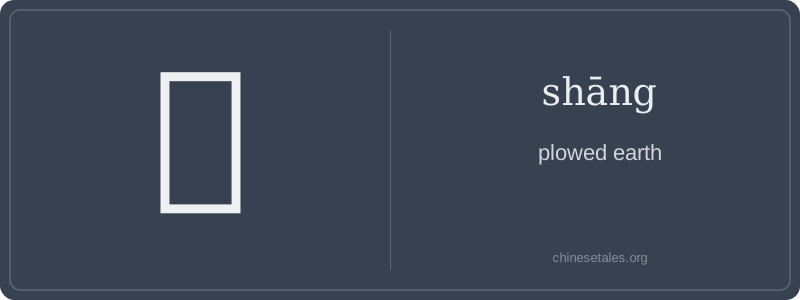
The earliest form of 墒 appears in Han dynasty seal script—not oracle bone, but already highly stylized: a left-side 土 (earth) radical anchoring the character, and a right-side 尚 (shàng, 'still, yet; noble') acting phonetically. But look closer: 尚 itself evolved from a pictograph of a tall ceremonial vessel under a roof—suggesting elevation, ritual care. So the original visual logic was 'earth treated with ritual attention'—not just dirt, but earth *prepared*, elevated by human intention. Over centuries, strokes simplified: the top of 尚 flattened into three horizontal lines (⺌), the middle became 日-like, and the bottom stabilized into 小—giving us today’s 14-stroke structure: 土 + 尚.
This etymological 'ritual earth' meaning hardened into agrarian precision. By the Tang, 墒 referred unambiguously to the ideal depth and friability of plowed land—critical for water retention in arid regions. The *Treatise on Farming Techniques* (Nongshu, 1313) notes '墒厚则苗壮' ('if the plowed layer is thick, seedlings thrive'), linking 墒 directly to life-giving porosity. Its visual duality—earth grounded, yet 'noble' (尚) in purpose—mirrors Confucian ideals: cultivation as moral and physical discipline, where turning soil is both labor and liturgy.
Imagine you’re walking with a farmer in the Loess Plateau at dawn—dust hangs golden in the air, and he stops beside a freshly turned field, crouches, and runs his fingers through the dark, crumbly soil. 'Zhè shì yī kuài hǎo shāng,' he says—'this is good plowed earth.' That’s 墒: not just 'soil' or 'earth' (that’s 土 or 泥), but specifically the loose, aerated, workable layer created by plowing—a noun that evokes texture, readiness, and agrarian rhythm. It’s poetic, technical, and rare in daily speech: you’ll hear it in agricultural reports, ecological studies, or classical poetry about land stewardship—not in ordering dumplings.
Grammatically, 墒 functions almost exclusively as a noun, often modified by measure words like 一墒 (yī shāng) or adjectives like 深墒 (shēn shāng, 'deep-plowed earth'). It rarely appears in verbs or compounds without context—it doesn’t mean 'to plow' (that’s 耕 or 犁), nor does it mean 'fertile' (that’s 肥沃). Learners sometimes misread it as shàng (like 上) or confuse it with 商 (shāng, 'commerce'), leading to hilarious mistranslations like 'commercial earth'—a red flag that signals you’ve skipped the radical check!
Culturally, 墒 carries quiet reverence for tillage as an act of harmony—not domination—of the land. In pre-modern texts, it appears in farming manuals like the *Qimin Yaoshu* (540 CE), where '墒情' (shāngqíng, 'soil moisture condition') was assessed by hand-squeeze and crack-pattern observation. Today, it survives mainly in scientific and policy language—yet its persistence reminds us how deeply Chinese civilization is rooted in reading the earth’s breath, not just its yield.