墐
Character Story & Explanation
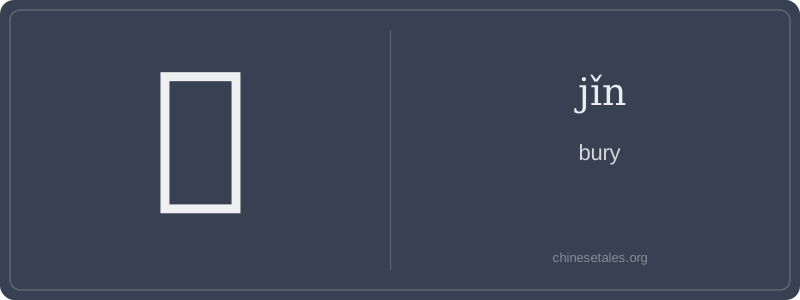
The earliest form of 墐 appears in late Warring States bamboo slips and Han dynasty seals — not oracle bones, but close enough! Visually, it’s a brilliant fusion: the left side is 土 (tǔ, ‘earth’), unmistakable and grounded. The right side is 堇 (jǐn), originally a pictograph of *withered grass over cracked earth*, symbolizing drought-induced desolation — later repurposed as a phonetic marker. In bronze script, the ‘grass’ part was more legible, but by the clerical script era, strokes simplified into the modern 堇 shape. Crucially, the character always kept its ‘earth + something fragile disappearing into earth’ visual logic — a buried thing vanishing *into* the soil, not just covered *by* it.
This visual logic shaped its meaning evolution: from concrete interment (e.g., ‘the duke was 墐 beneath the ancestral mound’) to metaphorical concealment — like 墐密 (jǐn mì, ‘hermetically sealed’, lit. ‘buried-tight’). In the Zuo Zhuan, it describes how defeated states ‘jǐn their banners’ — not literally burying cloth, but ritually retiring symbols of power, as if returning them to the earth’s custody. That’s the nuance: 墐 isn’t about hiding — it’s about *sacred withdrawal*, a final, respectful return to source.
Here’s the truth no textbook tells you: 墐 (jǐn) isn’t just ‘to bury’ — it’s *ritual burial*. Unlike common verbs like 埋 (mái), which covers everything from burying a time capsule to hiding keys, 墐 carries ancient solemnity. It implies deliberate, often ceremonial interment — of ancestors, sacred objects, or even abstract things like vows or regrets. You’ll almost never hear it in casual speech; it lives in classical texts, inscriptions, and formal historical writing. Think of it as the ‘archaeologist’s verb’ — precise, weighty, and deeply contextual.
Grammatically, 墐 is transitive and usually appears in literary or passive constructions. It rarely stands alone: you won’t say ‘I 墐 the dog’ — that’s unnatural and would sound archaic or even eerie. Instead, it appears in phrases like ‘墐于幽壤’ (jǐn yú yōu rǎng, ‘interred in the dark earth’) or in compound verbs like 墐埋 (jǐn mái), where 墐 intensifies the act with ritual gravity. Learners mistakenly use it as a synonym for 埋, but doing so risks sounding like a Tang-dynasty funeral director quoting poetry at a picnic.
Culturally, 墐 echoes China’s deep-rooted mortuary cosmology — burial wasn’t disposal, but *reintegration*: returning the body to earth (土) while honoring the spirit. Its rarity today makes it a linguistic fossil — preserved not by frequency, but by reverence. A common mistake? Confusing its radical (土) with the sound component (堇), then misreading it as jīn or jìn. Remember: the tone is third — jǐn — like a soft, deliberate *thump* of earth falling on a coffin lid.