墉
Character Story & Explanation
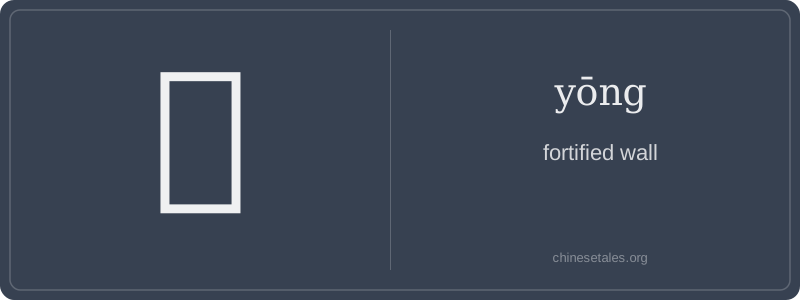
The earliest form of 墉 appears in bronze inscriptions of the Western Zhou dynasty (c. 1046–771 BCE), where it depicted a towering earthen rampart flanked by vertical battlements — two parallel vertical lines (representing watchtowers or crenellations) above a solid base (土). Over centuries, the top simplified into 幸 (xìng, originally a symbol of auspicious control), while the bottom remained 土 — merging meaning (fortification) with material (earth). By the Han dynasty, the structure stabilized: 幸 on top (suggesting guarded authority), 土 below (the very ground it defends), and the full 14 strokes locking in its solemn, grounded presence.
This character wasn’t born from abstraction — it was carved after real siege warfare. In the Zuo Zhuan, we read of states ‘repairing their 墉’ before invasions; in Du Fu’s poetry, 墉 looms silently at dusk, embodying both safety and sorrow. Its visual weight — that heavy, symmetrical balance of 幸 and 土 — mirrors how ancient Chinese saw defense: not brute force, but disciplined earth made sacred by vigilance. Even today, when restorers rebuild sections of Luoyang’s old city walls, they refer to the surviving earthen core as the ‘ancient 墉’ — honoring continuity, not just architecture.
At its heart, 墉 (yōng) isn’t just any wall — it’s a *fortified* one: thick, high, strategically built for defense, often surrounding ancient cities or palaces. It carries weight, history, and quiet authority — think less 'garden fence' and more 'Great Wall’s inner rampart.' In classical Chinese, it appears almost exclusively in literary, historical, or architectural contexts; you’ll never hear it in daily chat about apartment buildings or office walls. Modern usage is rare and highly stylized — mostly in poetry, historical novels, or formal descriptions of heritage sites.
Grammatically, 墉 functions as a noun and rarely stands alone. It’s nearly always part of a compound (like 城墉 or 女墙墉) or modified by classifiers like 座 (zuò) or 道 (dào). Learners sometimes wrongly treat it like 墙 (qiáng) — but swapping them is like calling the Pentagon ‘a room’: technically enclosed, but utterly missing the point of scale, purpose, and gravitas. You wouldn’t say ‘这堵墉’ — that’s unnatural; it’s ‘这座墉’ or ‘那道墉’.
Culturally, 墉 reflects China’s deep-rooted relationship with spatial hierarchy and protection — walls weren’t just physical barriers but symbols of order, sovereignty, and civilization versus chaos. A common mistake is overgeneralizing it to mean ‘any tall wall,’ which erases its military-historical resonance. Also, its radical 土 (earth/soil) reminds us that most early fortifications were rammed earth — not stone — a detail archaeologists love and textbooks often gloss over.