墈
Character Story & Explanation
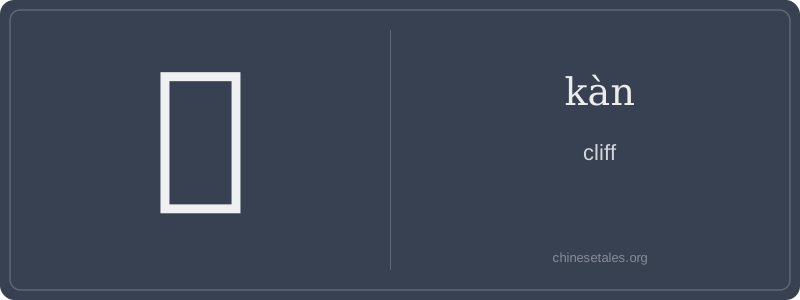
The earliest form of 墈 appears in late Warring States bamboo slips — not oracle bone, but a deliberate, elegant simplification. Its structure is striking: the left side is 土 (tǔ, 'earth'), drawn with three horizontal strokes representing layered soil; the right side is 干 (gān), originally a pictograph of a tree trunk or upright pole, here repurposed phonetically (kàn sounds close to gān in Old Chinese). Over centuries, the 干 evolved from a clean vertical stroke with two short arms into today’s compact, angular form — the top stroke shortens, the middle becomes a dot-like flourish, and the bottom stroke angles sharply downward, mirroring the cliff’s plunge.
This visual logic — 土 + 干 — tells a story: 'earth standing upright' → 'earth cut off vertically'. By the Han dynasty, 墈 was already used in texts like the *Shuōwén Jiězì* to describe riverbank bluffs along the Yellow River, where sediment layers collapsed into near-vertical faces. Unlike 崖 (yá), which emphasizes height and overhang, 墈 stresses *sheer verticality and exposed strata* — think of limestone cliffs revealing millennia of sedimentary history. Its rarity today reflects how precisely it names a specific geomorphological moment: not just 'a cliff', but 'the point where earth refuses to slope'.
Imagine standing at the edge of a windswept gorge in western China — not some gentle hillside, but a sheer, jagged 墈 where eagles nest on ledges barely wider than your hand. That’s the visceral weight of 墈 (kàn): not just any 'cliff', but a vertical, imposing, almost defiant rock face — raw, untamed, and geologically ancient. In Chinese, it evokes awe and danger, never casual scenery. You won’t hear it in everyday chat ('the cliff is pretty') — it’s literary, poetic, or topographic: used in place names, classical verse, or geological reports.
Grammatically, 墈 is a noun and rarely appears alone; it usually pairs with modifiers like 高 (gāo, 'high'), 陡 (dǒu, 'steep'), or in compounds like 墈壁 (kàn bì, 'cliff wall'). It doesn’t take aspect particles (了, 过) or measure words like 条 or 座 — instead, you’d say 一道墈 (yī dào kàn), using 道 as the standard counter for long, narrow natural features like cliffs, ravines, or ridges. Learners often mistakenly use it like 山 (shān, 'mountain') — but 墈 isn’t a whole landform; it’s the *edge*, the drop, the sudden termination of earth.
Culturally, 墈 carries a subtle Daoist resonance: it represents abrupt natural limits — places where human paths end and wildness begins. Mistaking it for 岩 (yán, 'rock') or 崖 (yá, 'precipice') is common, but 墈 is rarer, more technical, and visually distinct: its radical isn’t 山 (mountain) but 土 (earth/soil), emphasizing the *ground’s abrupt termination*, not elevation. It’s the kind of word that appears in Tang dynasty frontier poetry or modern hydrological surveys — never in HSK textbooks, but unforgettable once you see it carved into a canyon wall.